Chinese detector edges closer to solving the mystery of neutrino mass
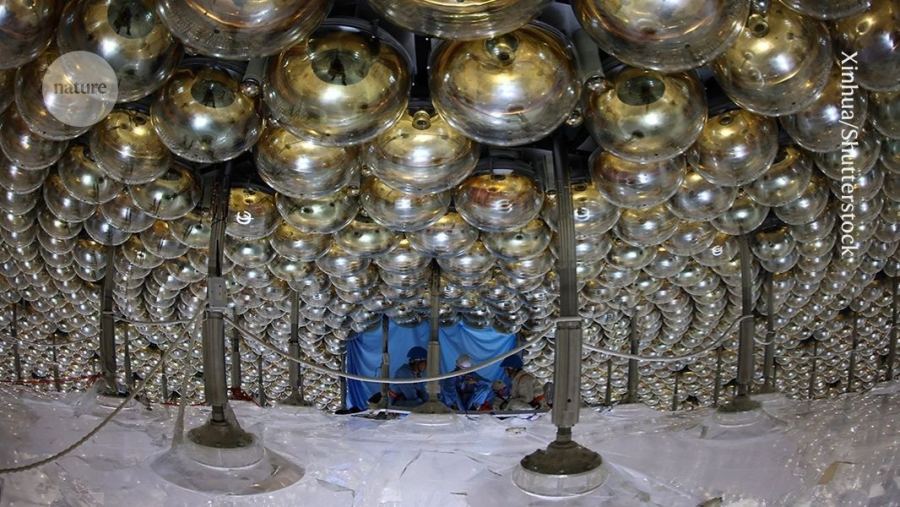
Physicists hope that the JUNO facility can determine which type of neutrino has the highest mass.
The gold-coloured photo tubes in China's neutrino detector are super efficient at collecting photons.Credit: Xinhua/Shutterstock
The first of a new generation of neutrino experiments has begun to make its mark. With just two months of data, the Jiangmen Underground Neutrino Observatory (JUNO) experiment in Guangdong, China, has captured crucial details of how the mysterious particles can switch identities in flight1, with better precision than all previous experiments. Such measurements are a step towards answering one of the biggest questions in particle physics: what is the origin of neutrinos’ tiny masses?
Atsuko Ichikawa, a physicist at Tohoku University in Sendai, Japan, says the first peer-reviewed publication of JUNO data is “a big deal for neutrino science”. “It’s impressive how the precision improved all at once,” she adds. The results were published today in Nature.
Physicist Wang Yifang, JUNO’s initiator and its spokesperson since its 2013 approval, says that many researchers had been sceptical that the machine could reach its planned sensitivity. “There were a lot of pangs, complications, difficulties, critical and painful moments, but I think in the end we feel very good about it,” says Wang, who is at the Institute of High Energy Physics in Beijing. “To be honest, I never had doubt that this could be done.”
Neutrinos are so light that they were once thought to have no mass, and the standard model of particle physics does not seem to explain why they do. Instead, physicists use experiments such as JUNO to study how neutrinos ‘oscillate’, or change from one type to another, which is the first step in answering the mass question.
JUNO consists of a 35-metre-wide wide acrylic sphere, filled with 20,000 tonnes of an organic solution. When a neutrino collides with a proton in one of its atomic nuclei, two successive, faint flashes of light occur, which are picked up by some of 43,000 light detectors, called photomultiplier tubes, that line the sphere. JUNO will conduct studies of neutrinos from many sources, including the cores of the Sun and Earth, supernova explosions and the atmosphere, but this paper focused on the detection of neutrinos produced by a nuclear reactor more than 53 kilometres away.
Neutrinos come in three ‘flavours’ — electron neutrinos, muon neutrinos and tau neutrinos. Nuclear reactors produce abundant electron neutrinos, some of which switch to another flavour by the time they reach the detector. Experiments such as JUNO count the number of electron neutrinos that make it without switching and — crucially — how that nu
📌 Kaynak
Bu özet naturecom kaynağından otomatik derlenmiştir. Tamamı için orijinal habere gidin.
Orijinal haberi oku →