Light slows down carbon nanotubes in water
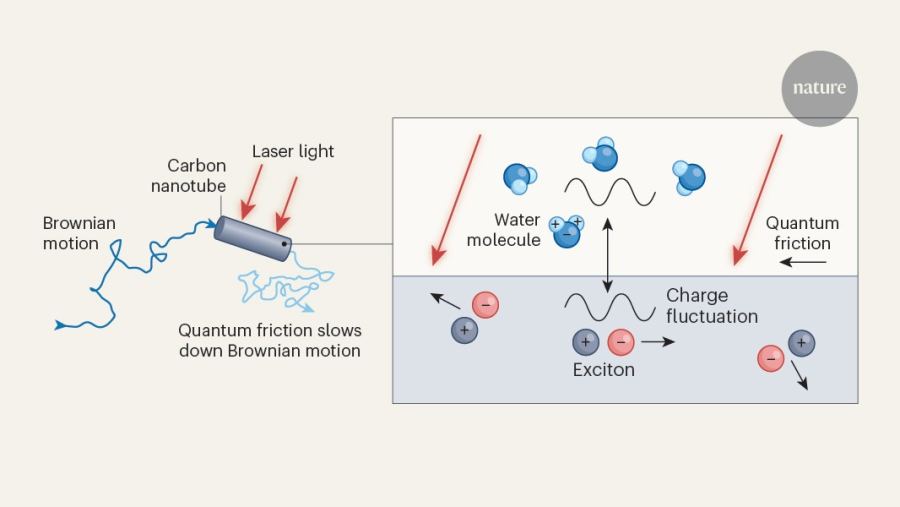
Water-suspended carbon nanotubes move more slowly in green light, suggesting that excited electrons in the tubes couple to the water through ‘quantum friction’.
Nikita Kavokine is in the Quantum Plumbing Lab, EPFL, Lausanne 1015, Switzerland.
“God made the bulk; the surface was invented by the devil.” This statement, attributed to the Nobel prizewinning physicist Wolfgang Pauli, who died in 1958, is perhaps even more on point today than it was during his lifetime. Condensed-matter theory can predict material properties in the interior, or bulk, of most conventional solids and liquids. But when it comes to their interfaces, surprisingly little is known: in particular, the nature of liquid–solid friction — in which energy is dissipated by liquid flowing over a solid — still puzzles researchers. Writing in Nature, Kistwal et al.1 report that when the liquid is water, the solid is a carbon nanotube and light shines on the system, the frictional-energy dissipation seems to involve subtle quantum effects.
Prices may be subject to local taxes which are calculated during checkout
Kistwal, T. et al. Nature https://doi.org/10.1038/s41586-026-10632-2 (2026).
Ackermann, J., Metternich, J. T., Herbertz, S. & Kruss, S. Angew. Chem. Int. Ed. 61, e202112372 (2022).
Kavokine, N., Bocquet, M.-L. & Bocquet, L. Nature 602, 84–90 (2022).
Coquinot, B., Bocquet, L. & Kavokine, N. Proc. Natl Acad. Sci. USA 121, e2411613121 (2024).
Read the paper: Light-induced quantum friction of carbon nanotubes in water
Light-confining device can control superconductivity — even in the dark
Improved quantum processor logical error rates via correction and detection
JUNO experiment ushers in next generation of neutrino experiments
How ice forms is a mystery — now scientists are cracking the case
In situ nanocrystal confinement for efficient blue perovskite LEDs
High-pulse-energy integrated mode-locked laser using a Mamyshev oscillator
Job Title: Deputy Editor, Nature Communications Locations: Shanghai and Pune – hybrid working model Application Deadline: July 10, 2026 (Candidates...
Join Human Technopole as a Postdoc in Molecular Epidemiology & Statistical Genetics and advance research that improves human health.
PhD Candidate to develop framework for 3D shape modeling and AI-based representation learning framework
Leibniz-Institut für Analytische Wissenschaften – ISAS – e.V.
Join HZAU's global faculty team to advance research with competitive benefits.
Job Title: Associate or Senior Editor Nature Water Location: Shanghai, Beijing and Milan – hybrid working model Application Deadline: July 10, 2026...
📌 Kaynak
Bu özet naturecom kaynağından otomatik derlenmiştir. Tamamı için orijinal habere gidin.
Orijinal haberi oku →