Inside the town at the frontline of the Ebola epidemic
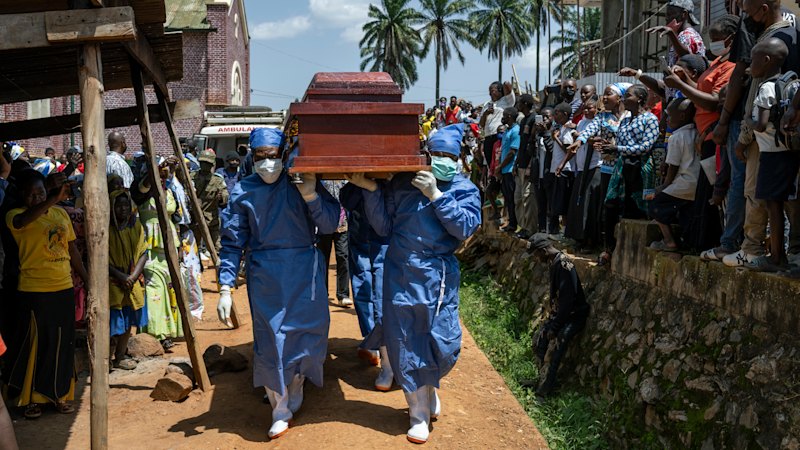
Medical workers, armed with the most rudimentary equipment and a dwindling supply of protective suits, masks and water, are waging a desperate fight against a deadly disease.
Mongbwalu, Congo: In the cramped, dilapidated Ebola ward, a 5-year-old boy languished on a bare mattress, a tissue stuffed into his nose to stanch the incessant bleeding. His father stood over him, eyes clouded with worry.
A few beds away lay the body of Christiane Bahati, 21, who had died seven hours earlier but had not yet been taken away. Her shoes were still tucked under the bed, her wailing relatives gathered outside the ward doors.
The body, covered by a thin sheet, was highly contagious. Yet hardly anyone in the ward was protected. Relatives came and went, carrying food and water to ailing patients because the hospital had none to give them. A few wore rubber gloves or pulled a scarf across their mouths. Most had nothing at all.
In the next ward lay the hospital’s laboratory technician, also sick. Seven other hospital workers had already died from suspected Ebola. Few of the staff members had ever been trained to fight the disease, and the most rudimentary equipment was in dangerously short supply: tests, protective suits, goggles, masks, even drinking water.
Outside, the sound of hammering broke the hushed silence. Aid workers from Doctors Without Borders were racing to erect isolation tents and disinfection stations.
Dr Alex Bogole, a Congolese doctor in the hospital’s intensive care ward, was furious. The virus had been spreading for months, virtually unimpeded, “and this is the best we can do?” he said, the frustration pouring through his protective gear.
This is the epicentre of the Ebola outbreak in Congo, and the frontline is completely overwhelmed.
The Congolese Health Ministry declared the outbreak on May 15, and it has ballooned into the third-largest on record. Two weeks later, the international response is being outpaced by the virus, and there is almost nothing to slow it down. Aid groups warn that without urgent intervention, this could be the world’s deadliest Ebola outbreak ever.
Bogole was never trained for this and was angry at everyone – at the Congolese government for failing to detect the outbreak until perhaps six weeks after it began, and at the world, which has barely mobilised help here in Mongbwalu, a remote gold mining town of about 150,000 where the outbreak is believed to have started.
“They hold meetings and meetings,” he said, struggling to contain his disdain. “What is the purpose of these meetings? People are dying, people are getting infected, people are in danger. It’s very slow.”
I arrived here with Arlette Bashizi, a photographer for The New York Times, after taking a bumpy, three-hour journey from th
📌 Kaynak
Bu özet Sydney Morning Herald kaynağından otomatik derlenmiştir. Tamamı için orijinal habere gidin.
Orijinal haberi oku →