A compelling biography of A.D. Hope asks us to rethink his literary legacy
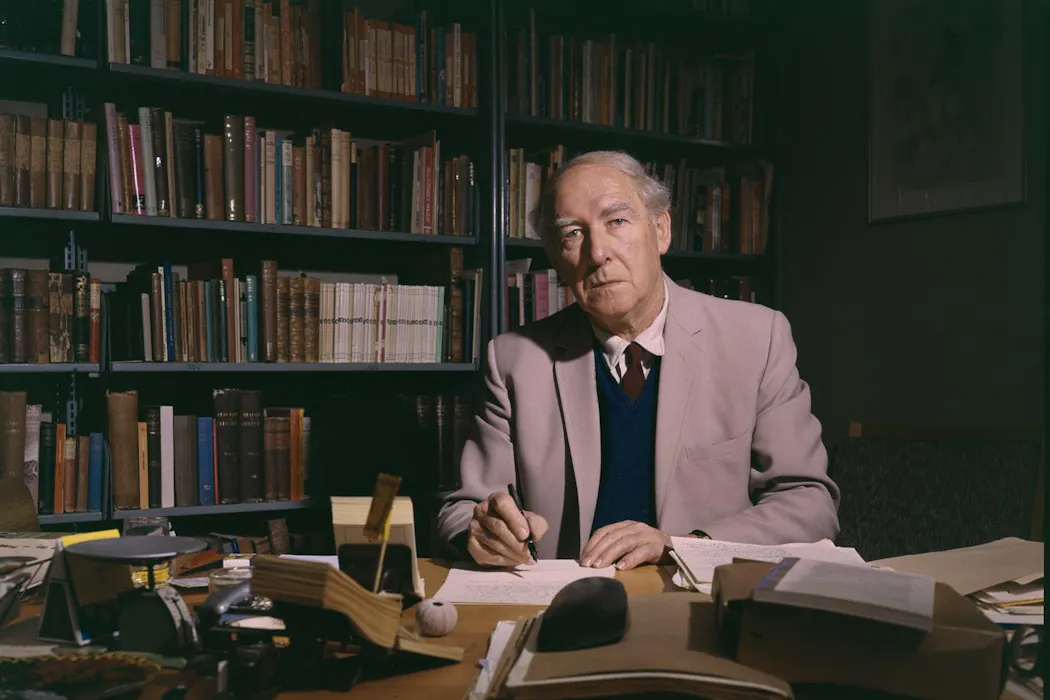
A.D. Hope. National Archives of Australia , CC BY-NC-ND I began teaching Australian literature not long after the death of Alec Derwent (A.D.) Hope (1907-2000). Despite Hope’s canonical status, I – like many – overlooked him, gravitating to writers more engaged with feminist, environmental, postcolonial and decolonial questions, or to those whose poetry was freshly modern, postmodern or experimental. Hope seemed conventional and dated by comparison. Such assumptions were rein
A.D. Hope. National Archives of Australia , CC BY-NC-ND I began teaching Australian literature not long after the death of Alec Derwent (A.D.) Hope (1907-2000). Despite Hope’s canonical status, I – like many – overlooked him, gravitating to writers more engaged with feminist, environmental, postcolonial and decolonial questions, or to those whose poetry was freshly modern, postmodern or experimental. Hope seemed conventional and dated by comparison. Such assumptions were reinforced by his most anthologised poem, Australia (1943), with its image of the land as menopausal woman: She is the last of lands, the emptiest, A woman beyond her change of life, a breast Still tender but within the womb is dry. And even allowing for its time of writing, this poem’s silence about Australia’s First Peoples presents a barrier for many readers. In short, why bother? Review: A.D. Hope: A Life – Susan Lever (La Trobe University Press ) Susan Lever’s compelling biography A.D. Hope: A Life asks us to stop and think again. Well aware of what will strike readers as problematic, Lever prompts us to revisit Hope’s writings. Tracing the life, career and achievement of this “grand old man”, the all-but-forgotten poet and professor, Lever documents his contribution to Australian literary culture during a formative period of postwar nation building. That the biography yields an excellent cultural history is one of its attractions. But even more arresting is what Lever shows about the philosophical reach, formal brilliance and impassioned force of Hope’s poetry. It’s the poetry that stands at the core of this biography. The poetry speaks into the gaps left, for instance, by embargoed letters. It dramatises the contradictory aspects of Hope’s life as suburban husband and father, as philanderer and poet-professor, as radio broadcaster for children, as savagely caustic reviewer, and as generous mentor to young writers. The reverse is also true: we see how the paradoxes shaping his intellect, passions, views and desires are imprinted within and generative of the poetry. This is apparent in both the poetry’s formal design and its content. Hope’s university education was checkered: a stellar undergraduate career at Sydney, a disappointing third-class honours degree at Oxford, then teacher training. But this period exposed him to psychology, especially Freud, and fostered his love of philosophy, languages and philology. It also inspired his abiding admiration of 17th- and 18th-century poets and satirists like Ben Jonson, Alexander Pope and Jonathan Swift. Enamoured of this neoclassical literary tradition, Hope resisted the dominant, post-romantic modes and forms of his own time: the personal lyric and free verse. He instead turned towards, and advocated for, the liveliness of discursive forms like the long narrative poem, the satire, the meditation and the epistle. These, he wrote in his essay The Discursive Mode (1956), allowed for “narrative, drama, excogitation, argument, description”. They were, in other words, forms for thinking with. The poetry is dark, the poetry is bleak, the poetry is funny, the poetry is joyful. And it is disciplined. Inhabiting a variety of older forms and modes, the poetry is always precise, metrically controlled and rhymed. At the same time, Hope makes his verses think and speak. His poems voice ideas and questions, canvassing matters that still press on us today: Go tell those old men, safe in bed, We took their orders and are dead. ( Inscription for a War , 1971) Returning to the poetry, we discover that Hope’s invocation and remodelling of traditional forms – of classical, biblical and mythical scenes, and of 17th- and 18th-century texts – is what makes his poetry modernist in form and spirit. Darkness and bawdiness Lever’s biography takes us from Hope’s idyllic childhood in Tasmania to his old age as the “great panjandrum of Canberra” (in Patrick White’s vengeful phrase ). In Lever’s telling, productive antinomies recur. Poems drawn from childhood, such as Ascent into Hell and Observation Car from his collection The Wandering Islands (1955), are haunted by darkness and existential dread. Observation Car recalls a train journey away from home. Not unlike Walter Benjamin’s backward-gazing angel of history , the poet is spellbound, transfixed by receding time as the train hurls him relentlessly onward: Only the past is assured. From the observation car I stand looking back and watching the landscape shrivel, Wondering where are we going and just where the hell we are. Yet Observation Car also contains images that objectify women’s bodies, a pattern that recurs elsewhere in Hope’s poetry. His bawdy verse satires, penned during and beyond his student years, together with his ongoing preoccupation with sexuality, earned him the nickname of “Phallic Alec”. Cover of A.D. Hope first book of poetry The Wandering Islands
📌 Kaynak
Bu özet The Conversation AU kaynağından otomatik derlenmiştir. Tamamı için orijinal habere gidin.
Orijinal haberi oku →