Piezomagnetoelectric effects in a candidate Kitaev magnet
The exactly solvable Kitaev model with its frustrated bond-dependent interactions has attracted enormous attention due to its exotic physics hosting fractional spin excitations as well as its promising prospects for quantum information technology. However, there is no pristine realization of the Kitaev model due to the significant Heisenberg and off-diagonal exchange interactions. While these additional exchange interactions are considered as obstacles on the route towards th
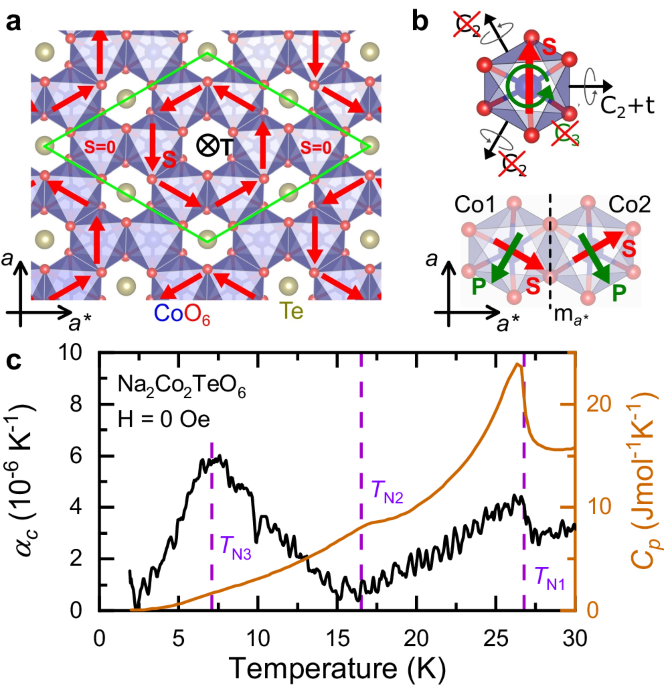
The exactly solvable Kitaev model with its frustrated bond-dependent interactions has attracted enormous attention due to its exotic physics hosting fractional spin excitations as well as its promising prospects for quantum information technology. However, there is no pristine realization of the Kitaev model due to the significant Heisenberg and off-diagonal exchange interactions. While these additional exchange interactions are considered as obstacles on the route towards the desired Kitaev quantum spin liquids, the interplay between these magnetic anisotropies and the Kitaev interaction has lead to numerous intriguing phenomena. Here we demonstrate a new phenomenon, the coexistence of the Kitaev interaction with the piezomagnetoelectric effect (simultaneous magnetoelastic and magnetoelectric responses), which can offer electric field driven manipulation of the ground state and the fractional spin excitations. Our study reports the direct observation of the magnetoelectric (ME) effect in a Kitaev-Heisenberg, the quantum spin liquid candidate Na2Co2TeO6, and highlights the magnetoelastic response as a sensitive gauge of phase transitions. We discuss that the ME effect originates from the pd-hybridization mechanism, which allows local polarization independently from any magnetic order. This mechanism can transfer the frustrated magnetic interactions onto the polarization system, potentially creating a new exotic electronic state, a polarization liquid. Experimental interrogation of the Kitaev model is typically frustrated by the presence of additional exchange interactions, necessitating careful tuning with applied magnetic fields or pressure in real materials. Here, Kocsis et al find a Kitaev candidate material with a magnetoelectric effect, opening up the possibility of using electric fields as a tuning parameter in the experimental study of the Kitaev model.
📌 Kaynak
Bu özet naturecom kaynağından otomatik derlenmiştir. Tamamı için orijinal habere gidin.
Orijinal haberi oku →