Narrow band gap and room-temperature ferromagnetism in Cr-doped ZnO nanorods fabricated by electrochemical deposition
This study reports on the structural, optical, and magnetic properties of Cr-doped ZnO nanorods (NRs) fabricated via a one-step electrochemical deposition process. The impact of Cr3⁺ doping was systematically investigated across concentrations of 0.00, 0.1, 0.5, 0.7, and 0.9 mM, with the resulting samples labelled S0, S1, S2, S3, and S4, respectively. The XRD confirmed the successful substitution of Cr3⁺ into the wurtzite ZnO lattice, but with a few amounts of the ZnCr₂O₄ sec
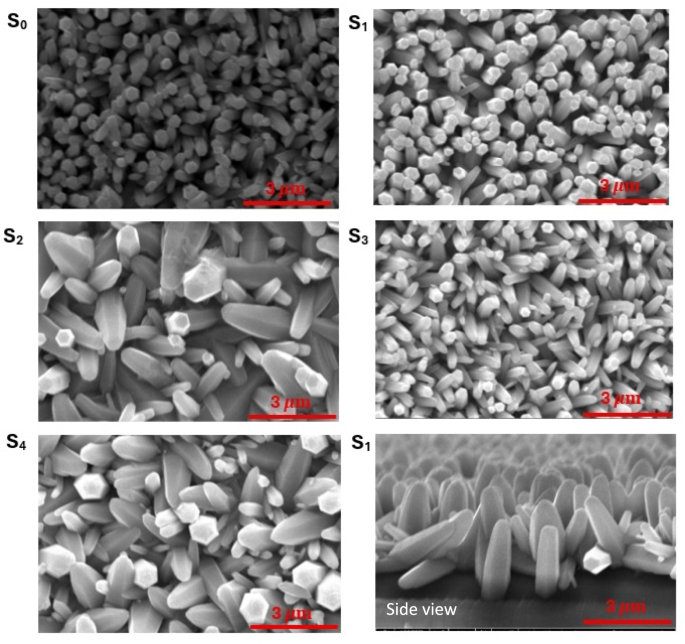
This study reports on the structural, optical, and magnetic properties of Cr-doped ZnO nanorods (NRs) fabricated via a one-step electrochemical deposition process. The impact of Cr3⁺ doping was systematically investigated across concentrations of 0.00, 0.1, 0.5, 0.7, and 0.9 mM, with the resulting samples labelled S0, S1, S2, S3, and S4, respectively. The XRD confirmed the successful substitution of Cr3⁺ into the wurtzite ZnO lattice, but with a few amounts of the ZnCr₂O₄ secondary phase obtained at 2θ = 43.5° for S3 and S4. The SEM micrographs show a significant morphological evolution from high-aspect-ratio nanorods to stubby, thickened structures. In general, the crystallite size and the ratio of diameter/length increase against Cr doping up to S3 and then decrease. The Cr-doped NRs (S1-S4) show enhanced absorption in the visible region (400–600 nm) compared to undoped S0. Additionally, the increase in the Cr leads to a decrease in the optical band gap from 3.42 eV for S0 to 3.23 eV for S4, as determined by Tauc’s plot. All NRs exhibit ferromagnetic and diamagnetic behavior at 300 K, whereas the behavior changes to ferromagnetic and paramagnetic with decreasing temperature to 10 K. In addition, the M-H curve develops a little bit of curvature between 0.00 and 3000 Oe to be likely similar to the well-known hysteresis loop of ferromagnetism. To isolate the intrinsic ferromagnetic signal, we subtracted the linear diamagnetic or paramagnetic background from the raw M-H data. The extracted ferromagnetic parameters of (Ms), coercive field (Hc), squareness (Sq), and anisotropy (γ) are obtained, and it is found that they are dependent on the chosen Cr concentration and temperature. Although most of them are affected by Cr doping, the values of Ms and γ at 10 K are higher than those of 300 K, whereas the vice is true for the Hc and Sq. The field cooling (FC) and zero-field cooling (ZFC) curves of S0 and S1 splitting across the temperature range (10–300 K). In contrast, introducing Cr drastically changes this picture since FC and ZFC curves completely overlap with each other. The Curie temperatures are between 299.95 and 299.99 K for the NRs (S0-S4). These findings establish electrochemical deposition as a viable route for fabricating Cr:ZnO NRs with narrow band gaps; paramagnetic and RTFM behaviors are tuneable multifunctional properties in visible-light optoelectronics, medical treatments, and spintronics.
📌 Kaynak
Bu özet naturecom kaynağından otomatik derlenmiştir. Tamamı için orijinal habere gidin.
Orijinal haberi oku →