Fractional-order systems for neuromorphic computing: software and hardware opportunities and challenges
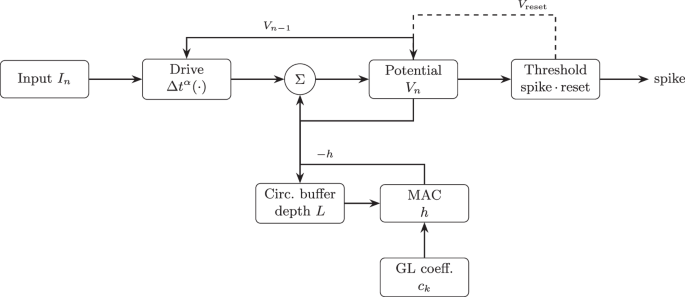
Fractional-order dynamics introduce scale-free memory and non-Markovian behavior into dynamical systems, offering a principled means of modeling long-term temporal dependencies. In this work, we extend the reservoir computing (RC) framework to include fractional-order neurons, yielding fractional-order reservoirs whose dynamics are continuously tunable through the fractional order α. We show that varying α systematically reshapes the reservoir’s information-processing regime:
Fractional-order dynamics introduce scale-free memory and non-Markovian behavior into dynamical systems, offering a principled means of modeling long-term temporal dependencies. In this work, we extend the reservoir computing (RC) framework to include fractional-order neurons, yielding fractional-order reservoirs whose dynamics are continuously tunable through the fractional order α. We show that varying α systematically reshapes the reservoir’s information-processing regime: with memory capacity, active information storage, and information transfer each peaking at distinct values of α. This identifies α as a new control parameter of reservoir dynamics, governing a trade-off between memory retention and sensitivity to new inputs. We present a theoretical analysis of fractional-order reservoirs, provide practical software and hardware realizations, and evaluate performance across three benchmark domains: spoken-digit classification, cart-pole control, and diabetes prediction. Together, these results establish fractional-order reservoir computing as a general and effective extension of the RC paradigm.
📌 Kaynak
Bu özet naturecom kaynağından otomatik derlenmiştir. Tamamı için orijinal habere gidin.
Orijinal haberi oku →