Scalable quantum photonic platform based on site-controlled quantum dots coupled to circular Bragg grating resonators
The scalable integration of solid-state quantum emitters into photonic nanostructures remains a central challenge for quantum photonic technologies. Here, we demonstrate a robust and streamlined integration strategy that tackles the long-standing issue of deterministic fabrication on randomly positioned self-assembled quantum dots (QDs), leveraging a buried-stressor-based site-controlled InGaAs QD platform. We show that this deterministic growth approach enables precise spati
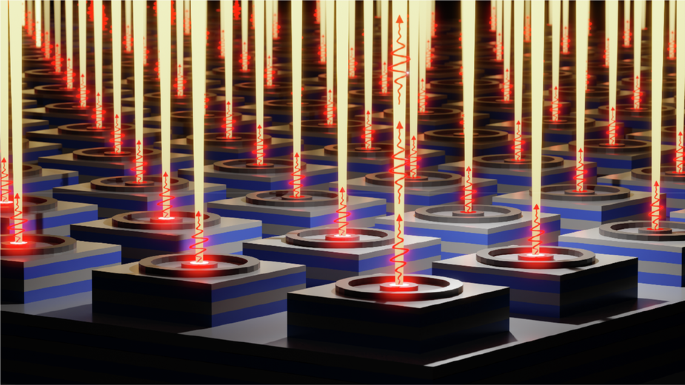
The scalable integration of solid-state quantum emitters into photonic nanostructures remains a central challenge for quantum photonic technologies. Here, we demonstrate a robust and streamlined integration strategy that tackles the long-standing issue of deterministic fabrication on randomly positioned self-assembled quantum dots (QDs), leveraging a buried-stressor-based site-controlled InGaAs QD platform. We show that this deterministic growth approach enables precise spatial alignment with circular Bragg grating (CBG) resonators for enhanced emission, eliminating the need for complex and time-consuming deterministic lithography techniques. We fabricated a 6 × 6 SCQD-CBG array with 100% device yield, with 35 devices falling within the radial-offset range where the simulated photon-extraction efficiency (PEE) exceeds 20%, underscoring the spatial precision and scalability of our fabrication concept. A systematically selected subset of five devices with varying radial displacements reveals clear offset-dependent trends in PEE, degree of linear polarization, spectral linewidth, and photon indistinguishability, thereby establishing quantitative bounds on spatial alignment tolerances. In the best-aligned QD-CBG device, we achieve a PEE of (47.1 ± 3.8)% (corresponding to an end-to-end system efficiency of 3.4%), a linewidth of (1.41 ± 0.22) GHz, a radiative decay lifetime of (0.80 ± 0.02) ns, a single-photon purity of (99.58 ± 0.18)%, and a Hong-Ou-Mandel two-photon interference visibility of (81 ± 5)% under quasi-resonant excitation at saturation power. We confirm our conceptual understanding of the effect of emitter-position dependent charge-noise fluctuations in terms of a quantum-optical model for the (quantum-)emission properties. The established nanofabrication platform provides a reproducible, lithography-compatible route to scalable, high-performance single-photon sources (SPS), offering a powerful alternative to conventional lithography-based deterministic integration techniques. Scalable marker-free integration of site-controlled quantum dots into circular Bragg grating resonators enables a high-yield array of bright, pure, and highly indistinguishable single-photon sources.
📌 Kaynak
Bu özet naturecom kaynağından otomatik derlenmiştir. Tamamı için orijinal habere gidin.
Orijinal haberi oku →