Spacewalking With Scott Wray, Artemis EVA Training Lead
6 Min Read Spacewalking With Scott Wray, Artemis EVA Training Lead Scott Wray conducts an underwater test of NASA’s Exploration Extravehicular Mobility Unit (xEMU) spacesuit in the Neutral Buoyancy Laboratory at Johnson Space Center in Houston. Credits: NASA/Bill Brassard Scott Wray’s experience with spacewalks started when he was about 6 years old. A tent resembling a lunar lander provided the perfect imaginary spacecraft. “I would lie on my back with my feet propped up on a
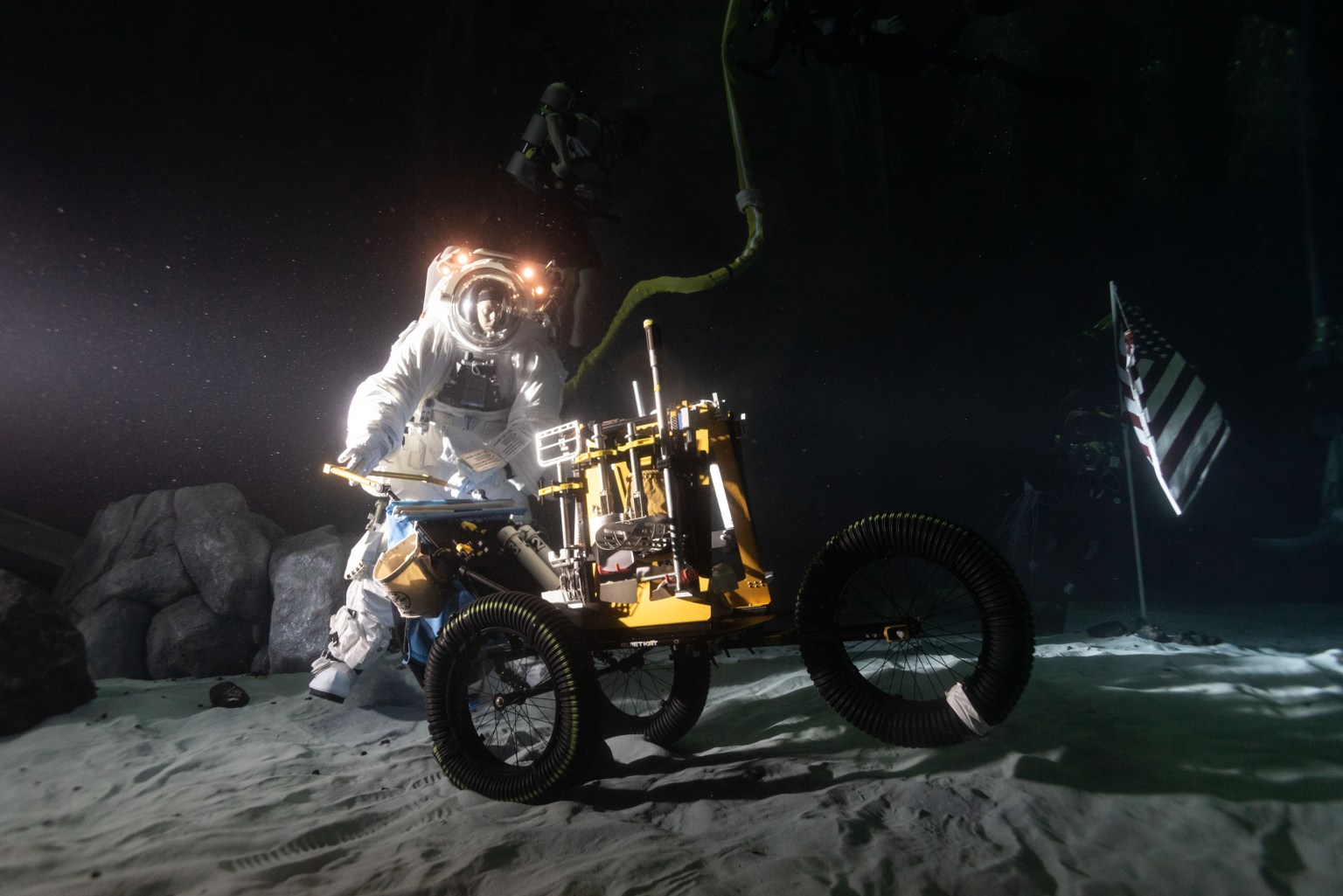
6 Min Read Spacewalking With Scott Wray, Artemis EVA Training Lead Scott Wray conducts an underwater test of NASA’s Exploration Extravehicular Mobility Unit (xEMU) spacesuit in the Neutral Buoyancy Laboratory at Johnson Space Center in Houston. Credits: NASA/Bill Brassard Scott Wray’s experience with spacewalks started when he was about 6 years old. A tent resembling a lunar lander provided the perfect imaginary spacecraft. “I would lie on my back with my feet propped up on a pillow as I imagined going through a launch countdown sequence,” he said. “Then I would exit the tent into a darkened bedroom and hop around just like the footage I had seen of Apollo astronauts.” Today, with more than 16 years at NASA’s Johnson Space Center under his belt, Wray is proud to have shaped spacewalk training across three eras of human spaceflight. Scott Wray smiles before a suited test run with Johnson’s Active Response Gravity Offload System. NASA/Josh Valcarcel The childhood fascination with spaceflight evolved into a passion for engineering, demonstrated through countless LEGO and airplane model builds and voracious readership of aircraft design books. His path to NASA was cemented by a week-long camp at Space Center Houston, which included several tours of Johnson’s signature facilities and a visit by former NASA Flight Director Gene Kranz. “I was so inspired by the facilities and the incredible history of this place, I knew that I had to work here someday,” he said. Wray participated in NASA’s Contractor Co-op Program with United Space Alliance while studying aerospace engineering at Embry-Riddle Aeronautical University and completed several tours with different organizations at Johnson. At the time, astronauts were training to conduct spacewalks, also known as EVAs, for both the Space Shuttle and International Space Station programs. During one co-op experience with the shuttle’s In-Flight Maintenance Team (IFM), Wray observed the IFM and EVA teams collaborating with the STS-117 crew to fix the peeled-back thermal blanket on space shuttle Atlantis’s Orbital Maneuvering System pod. He helped the teams develop crew procedures for practicing the repair inside the shuttle, using surgical staples and pins to tack the blanket down. “This real-time troubleshooting is where I learned about the EVA group and set my sights on working there during my final co-op tour,” he said. “I love to be hands-on, to take things apart and come up with creative solutions – that’s what really attracted me to EVA.” EVA work also reminded Wray of time spent as a dog mushing guide in Alaska. “That is where I got my first taste of expeditionary skills,” he said. “We lived in a remote glacier camp, taking care of 250 Alaskan Huskies. I learned how to make do with the tools you have and make repairs to a broken sled miles away from home.” At times, Johnson’s EVA team must create similar workarounds. “Some of our best moments as a team have come when our hardware or vehicle has malfunctioned, requiring us to devise a real-time solution,” he said. “It sounds scrappy, but I think it’s how we put the human into human spaceflight.” Wray became a full-time EVA team member at Johnson after graduation, working under various contracts until he transitioned to a civil servant position in 2021. He started as an EVA instructor focused on tools and hardware and teaching astronauts how to perform their maintenance and repair duties. As NASA’s astronaut corps evolved to include a wider range of backgrounds and body types, Wray worked to develop new EVA techniques and tools that could accommodate any crew member. “That meant creating a curriculum that capitalized on individual strengths while building teamwork and resilience,” he said. Scott Wray prepares JAXA (Japan Aerospace Exploration Agency) astronaut Kimiya Yui for an EVA training run in the Neutral Buoyancy Laboratory pool. NASA/Bill Stafford Wray also served as a flight controller for shuttle and space station EVAs. He remembers being on console in Johnson’s Mission Control Center during a space station EVA in July 2013. That excursion was terminated early after water began filling the spacesuit helmet of ESA (European Space Agency) astronaut Luca Parmitano, and the team could neither determine its source nor stop its flow. “That incident taught me that even after decades of operating a spacesuit, there are still failure modes we haven’t imagined,” he said. “It reinforced the need for vigilance, adaptability, and continuous learning—because in human spaceflight, lives depend on it.” In the last few years, Wray’s responsibilities shifted to preparing Artemis crew members for missions to the Moon. Now the Artemis EVA training lead, Wray oversees the development of training flows that will ready astronauts for lunar surface operations – a challenge NASA has not faced in over 50 years. Scott Wray participates in
📌 Kaynak
Bu özet NASA Breaking News kaynağından otomatik derlenmiştir. Tamamı için orijinal habere gidin.
Orijinal haberi oku →