AI agents keep giving confident wrong answers. The context layer is enterprise AI's next production problem.
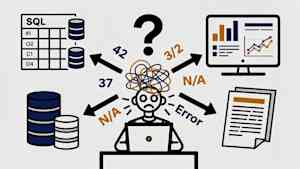
Enterprise AI agents have a new production failure mode, and it is not the model. As enterprises move from single-layer RAG to hybrid retrieval architectures, the same underlying data produces different answers depending on which agent, tool or system asks the question. Revenue means one thing in a business intelligence (BI) dashboard, something slightly different in a SQL table and something else again in an agent instruction. The retrieval infrastructure build-out of the pa
Enterprise AI agents have a new production failure mode, and it is not the model. As enterprises move from single-layer RAG to hybrid retrieval architectures, the same underlying data produces different answers depending on which agent, tool or system asks the question. Revenue means one thing in a business intelligence (BI) dashboard, something slightly different in a SQL table and something else again in an agent instruction. The retrieval infrastructure build-out of the past two years produced faster and cheaper vector search. It did not produce a shared definition of what the data means. At Snowflake Summit 26 in San Francisco, the data cloud vendor is taking a broad swing at that problem, with announcements spanning a Kafka-compatible managed streaming service called Data Stream, adaptive compute improvements, expanded Apache Iceberg interoperability and updates to its Cowork and CoCo agent and coding products. Running underneath all of it is a context layer: Horizon Context and Cortex Sense, a two-layer system designed to give agents a governed, shared definition of business logic across retrieval stacks. The context problem is why it matters: VentureBeat's VB Pulse Q1 2026 data, drawn from a survey of organizations with 100 or more employees, shows hybrid retrieval intent tripling from 10.3% in January to 33.3% in March, the fastest-growing strategic position in the dataset. "There are a lot of tools out there that you can ask questions, you get a very confident answer, but whether it's correct or not is different," said Christian Kleinerman, EVP of Product at Snowflake. From fragmented business logic to a governed context layer The problem Horizon Context targets is specific. Business logic today is distributed across SQL, BI dashboards and agent instructions, and no single system owns the definition. When multiple agents or tools query the same underlying data, they reason over different schemas and return different answers. Horizon Context is Snowflake's attempt to fix that at the catalog layer rather than at the agent layer. Horizon Context. The customer-managed layer, built on Snowflake's acquisition of Select Star. It pulls metadata from Postgres, SQL Server, Tableau and Power BI into the Horizon Catalog, so every agent, BI tool and external system draws from the same governed definition rather than reasoning independently over a raw physical schema. Semantic View Autopilot automatically creates and refines semantic views over time, extending curated business logic without requiring ongoing manual effort. Cortex Sense. The platform-derived layer. It automatically builds and enriches context from customer data and usage patterns on an ongoing basis, without requiring manual semantic view authoring. Kleinerman described it as improving the default experience before any explicit curation has happened. The distinction between the two layers is architectural and Kleinerman was precise about it. "Think of Horizon Context as everything that is explicit and declared by customers, and Cortex Sense is anything that is implicit and derived by us," Kleinerman said. The two layers connect to Snowflake's existing retrieval infrastructure. Cortex Search, the company's RAG implementation, plugs into both CoCo and Cowork as a tool, so context enriched by either layer flows into retrieval workflows. While Horizon Context is a Snowflake technology, the goal is for it to be interoperable and open. Snowflake is tying the technology to the Open Semantic Interchange, making customer-declared definitions portable across third-party catalogs and tools. "Horizon Context, 100% we're committed to and leading the effort to make sure that that's not locked in," Kleinerman said. Context layers are everywhere. The question is which ones actually work. Snowflake is joining an increasingly crowded field of vendors targeting the same problem. Microsoft has opened its Fabric IQ business ontology via MCP so any vendor's agent can draw from a shared semantic layer. Redis launched Iris , a context and memory platform that sits between agents and their data, built on a storage engine redesigned for agent-scale retrieval volumes. Pinecone is repositioning from vector database to knowledge engine with Nexus, which compiles enterprise data into task-specific artifacts before agents ever query them. Devin Pratt, research director at IDC, told VentureBeat that in his view Snowflake is headed in the right direction and is going where the whole market is heading. "Agents are only as good as the data and semantics behind them, so the context layer, not the model, is the thing to watch right now," Pratt said. In Pratt's view, what works about Snowflake's version is the split. Horizon Context covers what teams declare and curate themselves, and Cortex Sense covers what the platform picks up automatically. Just as important, they've anchored Hori
📌 Kaynak
Bu özet VentureBeat kaynağından otomatik derlenmiştir. Tamamı için orijinal habere gidin.
Orijinal haberi oku →