Sensitivity in phononic crystal sensors via super asymmetric coupled-cavity engineering
This work presents a one-dimensional super-asymmetric coupled-cavity phononic crystal sensor for concentration-dependent liquid analysis using an ethanol–water mixture as the sensing medium. The proposed structure consists of periodic acoustic mirrors surrounding an asymmetric coupled-defect region expressed as Air∣(A/B)7∣CL∣D∣CR∣(B/A)7 ∣Air, where the asymmetry is introduced through unequal coupling cavity thicknesses. The structural asymmetry modifies the acoustic confineme
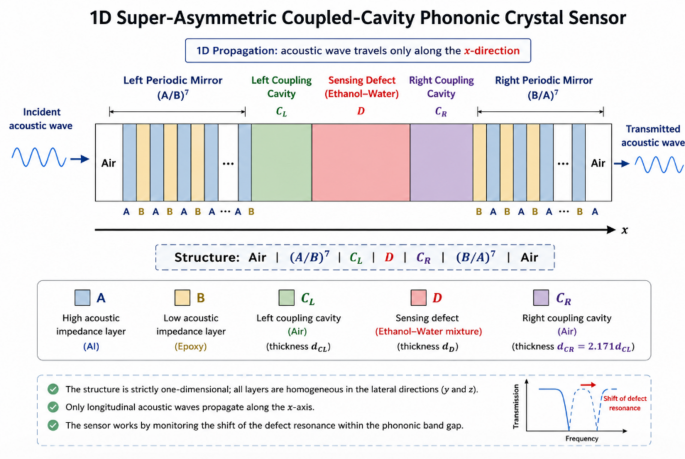
This work presents a one-dimensional super-asymmetric coupled-cavity phononic crystal sensor for concentration-dependent liquid analysis using an ethanol–water mixture as the sensing medium. The proposed structure consists of periodic acoustic mirrors surrounding an asymmetric coupled-defect region expressed as Air∣(A/B)7∣CL∣D∣CR∣(B/A)7 ∣Air, where the asymmetry is introduced through unequal coupling cavity thicknesses. The structural asymmetry modifies the acoustic confinement behavior inside the liquid defect cavity and enhances the resonance sensitivity to concentration variations. The transmission characteristics were analyzed using the transfer matrix method within the MHz frequency range. The obtained results demonstrate a stable and nearly linear defect-mode shift with increasing water fraction, achieving a sensitivity of approximately 4.90 × 10⁴ Hz.fraction− 1 with a correlation coefficient of R2 = 0.999990. In addition, the resonance quality factor varies from approximately 1080 to 335 depending on concentration, indicating a trade-off between resonance confinement and tunability. The resonance evolution was further examined through normalized spectral analysis and transmission distribution mapping, confirming continuous and spectrally distinguishable resonance behavior across the investigated concentration range. A fabrication tolerance study based on defect-layer thickness deviations between − 10% and + 10% revealed acceptable sensitivity stability, supporting the structural robustness of the proposed configuration. The obtained results indicate that the proposed super-asymmetric phononic platform can provide an effective and compact approach for liquid-concentration sensing applications based on acoustic resonance manipulation.
📌 Kaynak
Bu özet naturecom kaynağından otomatik derlenmiştir. Tamamı için orijinal habere gidin.
Orijinal haberi oku →