Design principles of soft integrated iontronics using gels
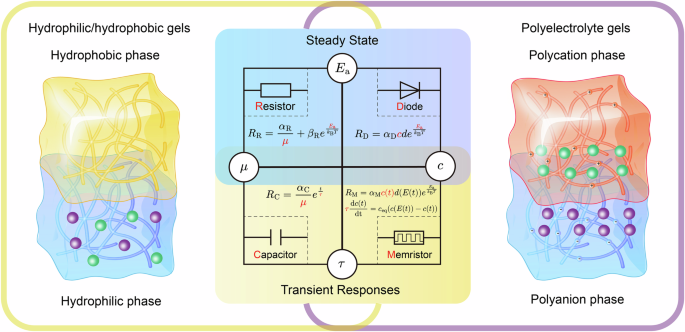
Soft iontronics based on ion-conducting gels overcome the integration, scalability, and biocompatibility limits of channel-based designs, enabling brain-like computing and brain-computer interfacing. Yet, the principles linking microscopic ion transport to targeted device functions remain elusive, impeding the vision that “the material is the device”. We establish a physics-based design framework grounded in ion hopping and diffusion in hydrophilic-hydrophobic and polyelectro
Soft iontronics based on ion-conducting gels overcome the integration, scalability, and biocompatibility limits of channel-based designs, enabling brain-like computing and brain-computer interfacing. Yet, the principles linking microscopic ion transport to targeted device functions remain elusive, impeding the vision that “the material is the device”. We establish a physics-based design framework grounded in ion hopping and diffusion in hydrophilic-hydrophobic and polyelectrolyte biphasic gels, as identified in recent experiments and simulations. Our molecular dynamics simulations and experimental evidence reveal that hydrophilic-hydrophobic gels, governed by interfacial energy barriers and mobility contrasts, act as tunable resistors and capacitors, while polyelectrolyte gels, through depletion-layer dynamics, realize rectifiers and memristors. These functionalities map seamlessly onto a unified equivalent-circuit model, enabling modular device design. Applying this theoretical approach, we engineer a soft iontronic brain-computer interface for signal acquisition, filtering, and processing, demonstrating the transition from materials theory to functional, biocompatible, and intelligent devices.
📌 Kaynak
Bu özet naturecom kaynağından otomatik derlenmiştir. Tamamı için orijinal habere gidin.
Orijinal haberi oku →