Unmasking Fresnel-zone limitations for robust respiration sensing in cell-free massive MIMO
Wireless signals can sense subtle physiological motion, such as human respiration, but their reliability is often undermined by Fresnel-zone limitations where amplitude or phase information collapses. We show that distributed Cell-Free Massive MIMO (CF-mMIMO) architectures provide a natural remedy, yet naive fusion of heterogeneous measurements leads to a new challenge of blind fusion. Here we present a unified framework that resolves both issues. At the single-AP level, we r
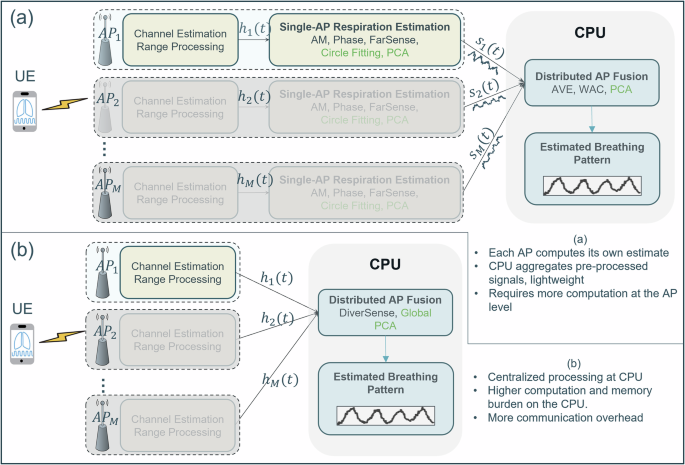
Wireless signals can sense subtle physiological motion, such as human respiration, but their reliability is often undermined by Fresnel-zone limitations where amplitude or phase information collapses. We show that distributed Cell-Free Massive MIMO (CF-mMIMO) architectures provide a natural remedy, yet naive fusion of heterogeneous measurements leads to a new challenge of blind fusion. Here we present a unified framework that resolves both issues. At the single-AP level, we reveal that respiration induces arc-like trajectories in the IQ plane and introduce Circle Fitting (CF) and principal component analysis (PCA) to unmask Fresnel-zone limitations. At the multi-AP level, we design adaptive fusion strategies, including weighted antenna combining (WAC) and PCA fusion, to align distributed observations efficiently. Simulations and experiments on a 64-antenna testbed show that PCA consistently outperforms conventional approaches at the single-AP level, while PCA-WAC achieves the best trade-off between accuracy and scalability at the multi-AP level. This work establishes a practical foundation for robust, unobtrusive respiration monitoring and advances the role of integrated sensing and communication (ISAC) as a core capability of sixth-generation (6G) networks.
📌 Kaynak
Bu özet naturecom kaynağından otomatik derlenmiştir. Tamamı için orijinal habere gidin.
Orijinal haberi oku →