AI could save us or destroy us. Too late now. We’re up to our eyeballs in it
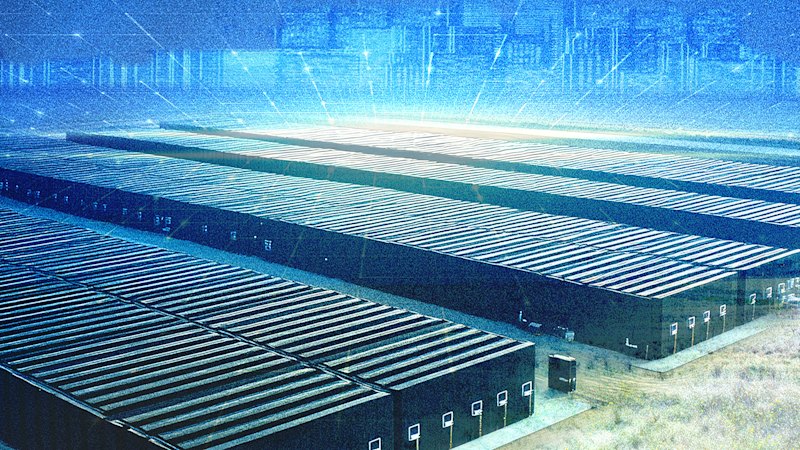
AI is promising an economic and medical nirvana. But from Gandalf to people watching new data centres in their communities, fear of AI is growing.
No matter your thoughts on artificial intelligence, whether it will be our saviour or plunge us into some dystopian sci-fi form of hell, the impact of the technology is being felt across Australia right now.
The nation is amid an AI infrastructure spending boom the likes of which we haven’t seen since the nation’s miners went on a tear in the early 2010s.
That boom, the biggest since the 1850s gold rush, delivered a fillip to miners’ bottom lines, powered China’s industrial revolution and pushed plenty of cash into certain governments’ coffers.
We’ve just got some idea of how big a boom is coming after the Australian Bureau of Statistics released figures showing a record $6 billion was spent by businesses on equipment linked to data centres and AI in the three months to the end of March. Take into account the new buildings to house all this stuff, and spending soared 84 per cent to $21.8 billion over the past year.
In percentage terms, spending on AI and data is growing faster than during that early 2010s mining boom.
Mining is traditionally the biggest source of this nation’s capital expenditure. But that is clearly under threat. AMP economists reckon that within the next five to 10 years, it will be data centres and AI.
Wednesday’s national accounts showed spending by the private sector on buildings and equipment is soaring in the two states where the AI construction boom is really under way – NSW and Victoria.
Through the first three months of this year, businesses in NSW spent a record $43.6 billion while their counterparts in Victoria outlaid their own record $34.6 billion. Not all the expenditure was on data centres and AI, but a sharply growing chunk was.
During the early 2010s mining boom, private capital spending in WA peaked at $32 billion. This year, it’s around $20.8 billion.
Westpac analysts believe that, combined with renewable energy projects (many of which are planned to power data centres), the country is looking at a $350 billion pipeline of data centre-related work over coming years.
All of this spending is being done on the expectation that this technology will deliver enormous productivity and economic breakthroughs.
From discovering cures to the worst diseases to slashing home construction time, proponents of AI believe it will deliver life-altering advances to humanity. Just a fortnight ago, a question that has bedevilled mathematics for eight decades – the planar unit distance problem – was solved by AI.
It’s easy to be seduced by the large numbers and the promises of hope. Who wouldn’t want the economy to grow strongl
📌 Kaynak
Bu özet Sydney Morning Herald kaynağından otomatik derlenmiştir. Tamamı için orijinal habere gidin.
Orijinal haberi oku →