Emergent detection of concept drift within the glia-inspired ‘rhythmic sharing’ algorithm
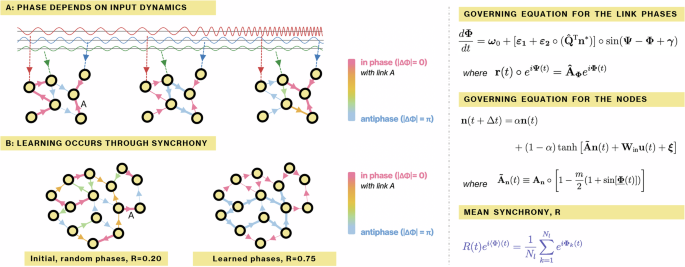
Biological rhythms coordinate adaptive sensing and computation, spontaneously demonstrating concept drift detection abilities. We demonstrate that our oscillatory learning scheme, called rhythmic sharing, can autonomously detect concept drift. Inspired by astrocytic oscillations, the algorithm has recurrent links that vary sinusoidally, producing emergent sensitivity to distributional drift. We introduce a new measure, called per-input synchrony, which harnesses this sensitiv
Biological rhythms coordinate adaptive sensing and computation, spontaneously demonstrating concept drift detection abilities. We demonstrate that our oscillatory learning scheme, called rhythmic sharing, can autonomously detect concept drift. Inspired by astrocytic oscillations, the algorithm has recurrent links that vary sinusoidally, producing emergent sensitivity to distributional drift. We introduce a new measure, called per-input synchrony, which harnesses this sensitivity to enable early and precise detection of hidden or complex drifts. Across three datasets, NASA C-MAPSS, SWaT, and WADI, the output of our per-input synchrony features improves detector performance, culminating in new state-of-the-art F1-scores on the complex SWaT and WADI datasets. These industrial datasets highlight the ability of our model to detect drift in highly-complex, real-world systems. Additionally, these results suggest that oscillatory link dynamics may serve as a general computational principle for adaptive sensing, with implications for neuromorphic hardware and astrocytic network biology.
📌 Kaynak
Bu özet naturecom kaynağından otomatik derlenmiştir. Tamamı için orijinal habere gidin.
Orijinal haberi oku →