Now you can hire people to carry your shopping bags in Delhi - will it work?
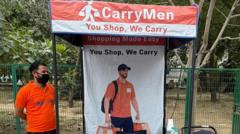
CarryMen employees don't just carry shopping bags - they also push prams and queue up at food counters.
Imagine if someone could carry your bags as you move from shop to shop. Or push your toddler's pram while you shop.
That's exactly what a new start-up is offering shoppers in a busy market in the Indian capital, Delhi.
Launched in April, CarryMen offers male and female assistants to shoppers in Lajpat Nagar market for up to four hours - starting at 79 rupees ($0.83; £0.62) for 30 minutes. An hour costs 149 rupees.
The service has gone down well with customers who say these CarryMen are making their lives a lot easier.
But it has also started a debate over whether the Indian middle class is too entitled and whether these assistants are just glorified "coolies" in exploitative jobs.
The start-up has been founded by friends Ritu Kandari Srivastava and Kanishka Malhotra - both mums of toddlers.
"The idea was born last year when Kanishka and I went to Lajpat Nagar with our toddlers. We found it really tough to manoeuvre our prams while carrying all our shopping bags," Ritu told the BBC.
"Also, we saw an older woman struggling with her bags and we wanted to help her. But we could barely manage our own things. That was very frustrating.
"So, we thought if there was a service where we could pay and get some help, we won't have to beg our family members to take us shopping."
Lajpat and many other markets frequented by Ritu, Kanishka and millions of Indians are not malls with even surfaces, escalators and air-conditioning. These are overcrowded open-air bazaars with footpaths that are missing or uneven or have been encroached upon by vendors, making it hard to navigate prams or sometimes even walk.
That evening the co-founders discussed the idea with their families and CarryMen began to take shape.
Over the next few months, they registered their company, got all permissions from the municipal corporation and police, and set up a kiosk in Lajpat Nagar.
Then they hired five young men - later also recruiting two women - and launched the service after a month of intensive training.
The start-up quickly went viral, with thousands sharing the news and dividing opinions on social media.
Many hailed it as an ingenious idea that could be scaled up to create thousands of jobs in a country where urban unemployment has consistently been higher than 5% with millions unable to find work.
But critics called it peak entitlement displayed by lazy affluent Indians who outsource all menial work and chores to domestic helpers.
Some of the backlash came after AI-generated photos appeared on social media, imagining well-dressed affluent women as prospective customers fo
📌 Kaynak
Bu özet BBC World kaynağından otomatik derlenmiştir. Tamamı için orijinal habere gidin.
Orijinal haberi oku →