NASA Says Farewell to MAVEN Mars Mission, Hosts Media Call Today
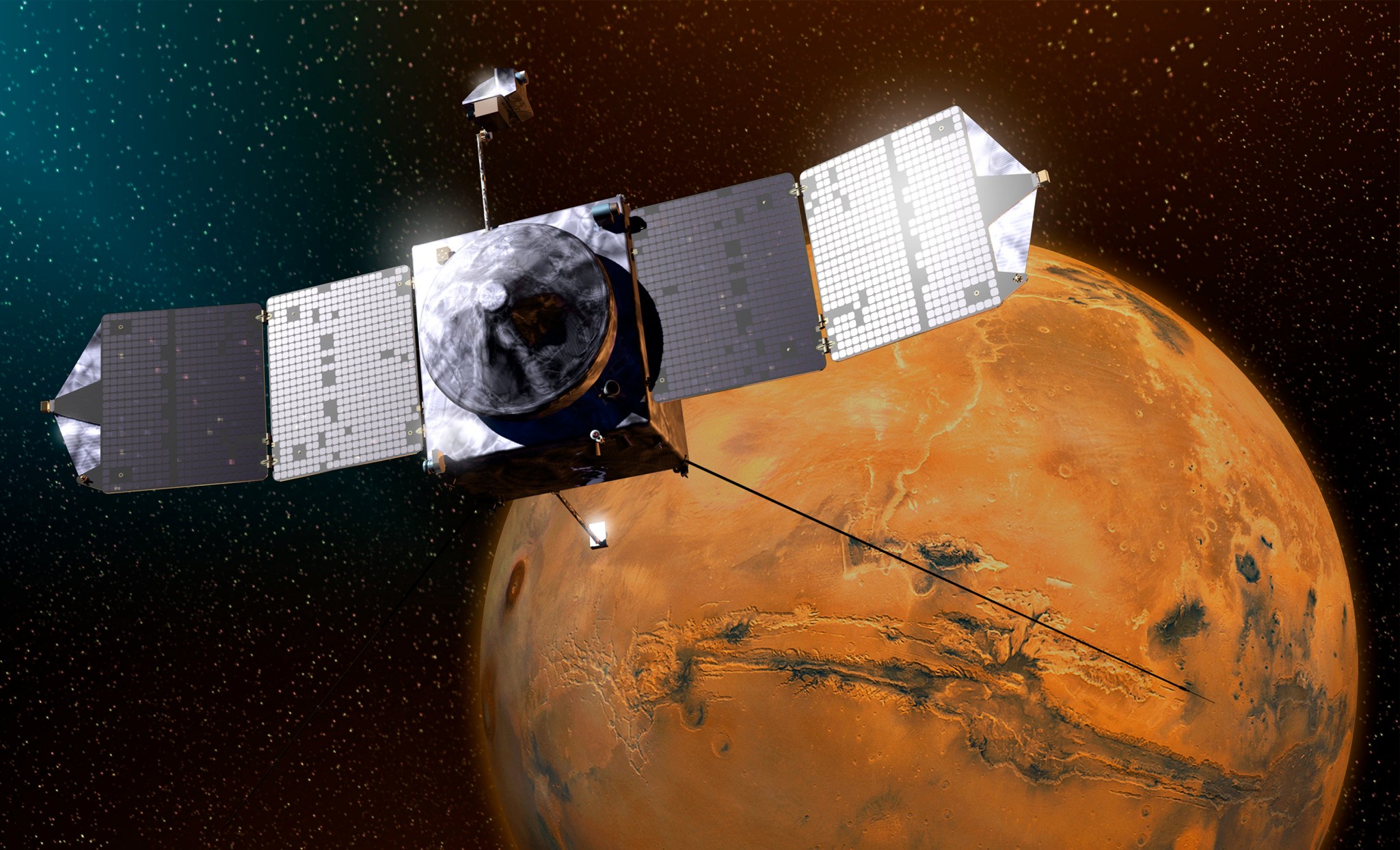
Artist’s concept of NASA’s MAVEN spacecraft at Mars. The spacecraft entered orbit around the planet in 2014 and has completed over eleven years of observing the Martian upper atmosphere, ionosphere, and interactions with the Sun and solar wind to explore the loss of the Red Planet’s atmosphere to space. Credit: NASA/Goddard/University of Colorado/Laboratory for Atmospheric and Space Physics The first mission devoted to observing the Martian atmosphere and its evolution, NASA’
Artist’s concept of NASA’s MAVEN spacecraft at Mars. The spacecraft entered orbit around the planet in 2014 and has completed over eleven years of observing the Martian upper atmosphere, ionosphere, and interactions with the Sun and solar wind to explore the loss of the Red Planet’s atmosphere to space. Credit: NASA/Goddard/University of Colorado/Laboratory for Atmospheric and Space Physics The first mission devoted to observing the Martian atmosphere and its evolution, NASA’s MAVEN (Mars Atmosphere and Volatile Evolution), has ended after more than 11 years in orbit at Mars and a decade beyond its primary, one-year mission. The spacecraft was heard last on Dec. 6, when it experienced an unexpected loss of signal after it passed behind the Red Planet. NASA will host a media teleconference at 2 p.m. EDT today, Wednesday, June 3, to discuss MAVEN’s achievements. The agency convened an anomaly review board in February to evaluate recovery efforts and assess the spacecraft’s probable current state. The review board has determined that the MAVEN spacecraft is not recoverable, and it is no longer capable of performing its science and data relay mission, which is consistent with the mission team’s findings. Telemetry from MAVEN prior to the spacecraft’s passage behind Mars in December showed all subsystems working normally. After the spacecraft emerged, NASA’s Deep Space Network (DSN) did not observe a signal. A brief fragment of telemetry data from analysis of radio signals recorded by the DSN’s open-loop receivers indicated the spacecraft was in safe mode and rotating at an unusually high rate when it emerged from behind Mars, indicating a disruption in MAVEN’s orbit trajectory. The review board concluded that due to this rotation, the batteries on the spacecraft had drained, causing the communications system to lose power and rendering MAVEN in an unrecoverable state. These preliminary findings do not address a potential root cause for the anomaly, which still is being investigated. The review board is expected to provide its final report later this year. NASA has begun the official process of decommissioning the MAVEN mission, following standard procedures to archive the full mission dataset for the science and exploration communities. “The science MAVEN has given us is key to informing what kind of radiation protection and safety measures we must take before sending humans to Mars,” said Louise Prockter, director of the Planetary Science Division at NASA Headquarters in Washington. “The data collected from MAVEN will continue to provide valuable insight into Mars for decades to come.” Launched in November 2013, the MAVEN mission explored the Red Planet’s upper atmosphere, ionosphere, and interactions with the Sun to explore the loss of the Martian atmosphere to space. Understanding atmospheric loss gives scientists insight into the history of the planet’s atmosphere and climate, liquid water, and planetary habitability. “The MAVEN mission has truly advanced our understanding of the Martian atmosphere and evolution. This dataset has had a tremendous impact on the field,” said Shannon Curry, MAVEN’s principal investigator and a researcher at the Laboratory for Atmospheric and Space Physics at the University of Colorado Boulder. “Our science team is exceptionally proud of all of these amazing discoveries.” Sun’s impact on Mars One of MAVEN’s first major results was that the erosion of Mars’ atmosphere increases significantly during solar storms . The team studied how the solar wind, which is a stream of charged particles continually streaming from the Sun, and solar storms continually strip away Mars’ atmosphere, as well as how this process played a key role in altering the Martian climate from a potentially habitable world to today’s cold, arid planet. The MAVEN mission made unprecedented strides in advancing our understanding of how the Sun and space weather affect Mars, as it was the only spacecraft that could simultaneously take measurements of both the Sun and the Martian atmospheric response. Martian light shows The MAVEN mission discovered several types of auroras that light up when energetic particles plunge into the atmosphere, bombarding gases and making them glow. The MAVEN team showed that protons create new kinds of auroras at Mars. On Earth, proton auroras only occur in very small regions near the poles, whereas at Mars they can occur everywhere. Mars’ atmosphere sputters into space To better understand how Mars lost most of its atmosphere, MAVEN measured atmospheric sputtering for the first time at any planet. The team did this by observing argon, which is a noble gas, meaning it rarely reacts with other constituents in the Martian atmosphere. The only significant way it can be removed is by atmospheric sputtering, a process where ions crash into the Martian atmosphere at high enough speeds that the
📌 Kaynak
Bu özet NASA Breaking News kaynağından otomatik derlenmiştir. Tamamı için orijinal habere gidin.
Orijinal haberi oku →