Enamel nanocrystal misorientation increased with meat-eating and agriculture
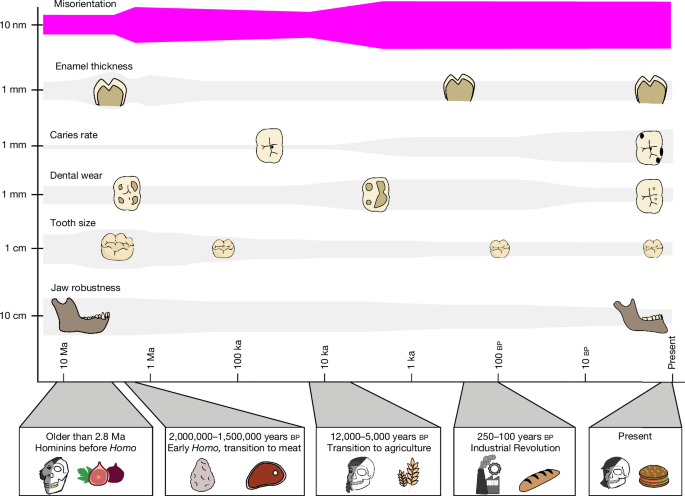
Enamel covers teeth, is the hardest tissue in the vertebrate body and has a complex multiscale structure from nanometres to millimetres1. The structure comprises thin, long hydroxyapatite (Ca5(PO4)3OH) nanocrystals2, 50–70 nm wide, many micrometres long, parallel and bundled into approximately 5-µm-wide rods. The rods undulate and cross into a microscale ‘decussation pattern’ that toughens enamel by deflecting cracks3,4. However, the crystallographic orientation of enamel nan
Enamel covers teeth, is the hardest tissue in the vertebrate body and has a complex multiscale structure from nanometres to millimetres1. The structure comprises thin, long hydroxyapatite (Ca5(PO4)3OH) nanocrystals2, 50–70 nm wide, many micrometres long, parallel and bundled into approximately 5-µm-wide rods. The rods undulate and cross into a microscale ‘decussation pattern’ that toughens enamel by deflecting cracks3,4. However, the crystallographic orientation of enamel nanocrystals is poorly understood. Here we show that the misorientation angle of adjacent nanocrystals varies markedly across 12 primate teeth spanning 9 species, 17.8 million years of evolution and diverse diets. Using a method called Polarization Enabled Large Input of Crystal Angles at the Nanoscale (PELICAN)5, we compare nanocrystals in the same (pre)molar locations and show that misorientation increases with food hardness in extant and fossil non-human apes and monkeys. We compare misorientation across three major dietary shifts in human evolution: the transition to meat-eating about 2.0–1.5 million years before present6,7, to agriculture (about 12,000 years before present)8,9, and the Industrial Revolution (about 250 years before present)10. We show that over the past 1.6 million years, in the human lineage misorientation increased with time, especially when meat and stone-ground grains were introduced into human diets, but not with the Industrial Revolution. Thus, besides macro-changes, teeth adapted to dietary change at the nanoscale and crystallographically. This observation suggests that misorientation may contribute to enamel’s resilience; thus, bioinspired materials may consider small misorientation angles for added resilience. An analysis of enamel nanocrystal misorientation in primate and human teeth across three major dietary shifts in human evolution shows that misorientation increased with harder diets, suggesting that misorientation contributes to enamel’s resilience.
📌 Kaynak
Bu özet naturecom kaynağından otomatik derlenmiştir. Tamamı için orijinal habere gidin.
Orijinal haberi oku →