What it’s really like to have a big family today
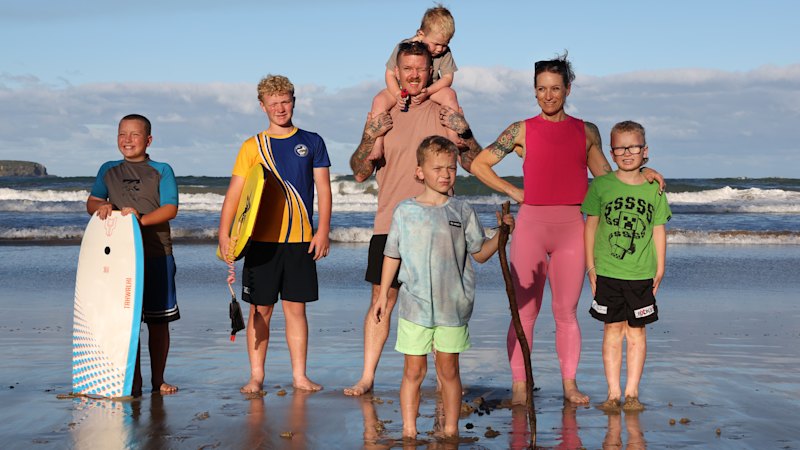
Stares at the supermarket. 3am starts. Batch cooking champions. As Australia’s fertility rate falls to a record low, families with four or more children are becoming a rare species.
Stares at the supermarket. 3am starts. Batch cooking champions. As Australia’s fertility rate falls to a record low, families with four or more children are becoming a rare species.
The sun has not yet risen over Batemans Bay, but no light is needed to see there are five boys living in the house ahead.
If the toy trucks and pushbikes we unsuccessfully dodge in the front yard hadn’t given it away, the rugby league replays blaring from the living room would have.
Quiet time for mum Steph Powell is the moments after her alarm rings at 3am. Her husband wakes up at 4am and is out the door within the hour, handing over to a babysitter three mornings a week.
It takes a village – and organisational skills envied by any military commander worth their salt – for the family of seven’s daily routine to run smoothly. People, says dad Mark Powell, think they’re “crazy”.
Steph has been packing lunches for Taj, 13, Harlo, 11, Hendrix, 9, and Sabre, 7, while calmly mediating the scuffles that have broken out every few minutes since the mysterious materialisation of a boxing glove.
“There’s so many of them, there’s always fighting,” the 39-year-old explains of her demeanour. Mark’s crusade, meanwhile, is the “constant” jumping.
“We try and stop them,” he says. “They jump off the couch. My dad built them the playhouse in the backyard, they jump off that onto the trampoline.”
The 40-year-old has come home after a short shift at one of the local cafes the couple own. He’s already running late for his full-time job as a firefighter.
Mark won’t leave, however, without ensuring Thor and Ziggy – the family’s French bulldog and bull mastiff – are fed.
Further delaying his departure is three-year-old Bodhi, who is losing patience at his father’s feet with his arms outstretched.
Mark picks up his youngest for the coveted cuddle, then heads out.
Much has been made of Australia’s record-low fertility rate, which fell to 1.48 in 2024. Part of that can be attributed to the increase in adults leaving their child-bearing years without children, whether by choice or against their will.
But a maelstrom has swallowed parents who, three decades ago, ordinarily would have had three or more children.
The soaring cost of living, lack of affordable family-sized housing, and a childcare system in crisis have killed that Australian dream for many.
According to census data, single-child families and those with two children increased by 45 and 37 per cent, respectively, between 2006 and 2021.
Some of Steph and Mark’s neighbours in their NSW South Coast town – where the median house p
📌 Kaynak
Bu özet Sydney Morning Herald kaynağından otomatik derlenmiştir. Tamamı için orijinal habere gidin.
Orijinal haberi oku →