Still standing: Inside ‘the most bombed hotel in Europe’
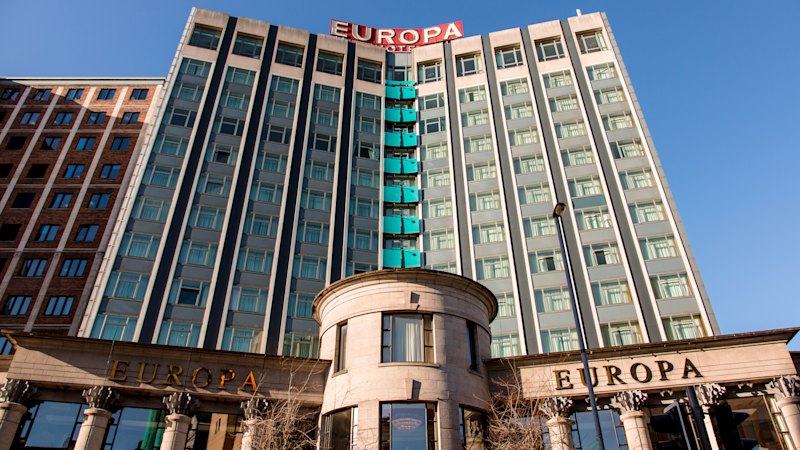
Tell a local you’re staying at the Europa and they’re bound to have a story to tell you about the property that withstood more than 30 bombings over three decades.
If you want to strike up a conversation with a Belfast local, just mention you’re staying at the city’s iconic Europa Hotel.
Everyone from a barista at a coffee stop, to a guide at Belfast’s Titanic Experience, to the fiddler at a pub taking a break, has stories to tell about this colourful landmark.
Opened in 1971 on the site of the former Great Northern Railway Station, it remains a symbol of resilience, after withstanding more than 30 bombings during the turbulent Troubles from the 1970s to the 1990s.
Nicknamed the “hardboard hotel” because shattered windows were boarded up so often, it was frequented by journalists, photographers and broadcasters reporting on the bloody conflict.
Step inside today’s elegant lobby and a commemorative installation showcases both the good times and the bad at what is known as “the most bombed hotel in Europe”.
“This is a hotel with a history, and despite many IRA bombings in and around the hotel, I believe no one was ever killed amid the injuries and near misses,” says the doorman.
“The Europa was a target because coverage was assured due to the on-site media.”
I embark on a trip down memory lane, looking at photos of charismatic hotel manager, the late Harper Brown, who was a master at evacuating guests, often after receiving a warning of an impending attack.
Despite damaged areas, he always did his best to keep the hotel operating.
Legend has it that he presented a commemorative tie to those who endured 17 or more evacuations.
Also, when the water supply was cut, he handed out half-bottles of champagne to guests – mainly media – to clean their teeth.
In those early days, the 12-storey landmark became a makeshift news hub with 20 telephone lines, a photographic darkroom and nooks to pen experiences that kept the world abreast of the political unrest.
Scoops and tip-offs were exchanged at the Whip and Saddle public bar, while the Beefeater Restaurant was where spooks, spies, paramilitaries and parliamentarians eavesdropped on each other.
The 12th-floor Penthouse Bar, where the favourite cocktail of the 1970s and ’80s was Forbidden Fruit – white peaches in flaming brandy – was the place to be seen.
In August 1993, local businessman Sir William Hastings purchased the hotel – great timing, soon after the IRA and Unionist paramilitaries signed a ceasefire agreement. It later led to the Good Friday Agreement, ending 30 years of sectarian violence.
Today, the slick four-star hotel has 272 stylish bedrooms and suites with city views.
It is our home for two nights on a Collette Best of Ireland tour, which featur
📌 Kaynak
Bu özet Sydney Morning Herald kaynağından otomatik derlenmiştir. Tamamı için orijinal habere gidin.
Orijinal haberi oku →