The real Robinson Crusoe has been reimagined with historical accuracy – except for the talking goat
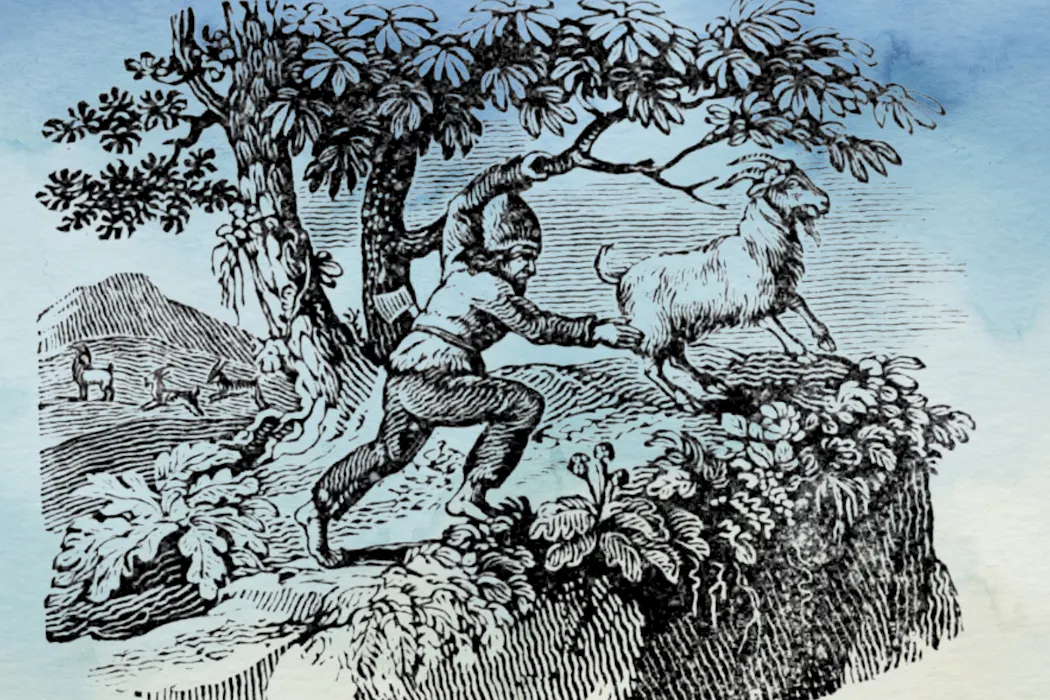
Selkirk catching a goat. Public domain, via Wikimedia Commons You might think you’ve already heard a story about someone marooned on an uninhabited island who needs to fight for survival. The iconic image of Tom Hanks desperately calling for Wilson, the anthropomorphised volley ball in Castaway (2000), probably comes to mind. There is also the juggernaut reality series Alone , the popularity of which raises questions about why its followers are so fascinated by isolation and
Selkirk catching a goat. Public domain, via Wikimedia Commons You might think you’ve already heard a story about someone marooned on an uninhabited island who needs to fight for survival. The iconic image of Tom Hanks desperately calling for Wilson, the anthropomorphised volley ball in Castaway (2000), probably comes to mind. There is also the juggernaut reality series Alone , the popularity of which raises questions about why its followers are so fascinated by isolation and survival. And then, of course, there is Daniel Defoe’s famous tale of Robinson Crusoe . Review: Cast Away: or, the Surprising Adventures of Alexander Selkirk – Francesca de Tores (Bloomsbury) Defoe’s book – the full title of which is The Life and Strange Surprizing Adventures of Robinson Crusoe, of York, Mariner – is widely considered the first English novel, though there are other contenders, including works by women who came before Defoe, such as Margaret Cavendish, author of The Blazing World (1666) and Aphra Behn, author of Oroonoko (1688). Published in 1719, amid the power struggle between the empires of England and Spain, Defoe’s tale was a runaway bestseller. It is still in print. Robinson Crusoe was loosely based on the experience of Alexander Selkirk , who was rescued in 1709 after spending over four years marooned on an island in the Pacific Ocean. Francesca de Tores’ new novel Cast Away returns to the inspiration for Defoe’s seminal work. It is not only the story of an escape into the simplicity (and drudgery) of life on a deserted island; it is a timely and reassuring consideration of human resilience and resourcefulness. It is also a testament to de Tores’s research: her willingness to draw from history and get elbow-deep in the goat skins. Research and authenticity Robinson Crusoe deviates from Selkirk’s lived experiences in some key details. Crusoe’s island is not in the Pacific but the Caribbean, where he is given the opportunity to attain dominion over nature and visiting humans for 28 years. Defoe also furnished his castaway with a shipwreck full of tables, chairs, tools, supplies and a dog, all of which helped him live a more comfortable existence. So did the fortuitous arrival of a human, whom he enslaved and named “Friday”. Though he is self-reflective, Crusoe is a character written for an audience that was widely accepting of the ethics and practices of imperialism. Many readers at the time were persuaded that Defoe’s novel was a true story. Its first-person narration proved a convincing technique to blur the edges of fact and fiction. These days, audiences demand more credibility from their historical narratives. We are bombarded with stories, in print and on screen. A discerning reader wants to shake out the dross and dedicate their reading time to something transporting and meaningful. This is an excellent reason why de Tores’s novel should rise to the top of our to-be-read lists. Cast Away respects its historical research, even as it deploys fictional tropes made familiar by its predecessors. Extensive notes at the end of Cast Away clearly set out the line where historical facts limited the telling of a rounded story, and where de Tores took narrative leaps and made educated guesses. The honesty is refreshing. It enhances reader trust and does not diminish the enjoyment of the novel. It is evidence of the author’s commitment to creating an immersive story. In a world flooded by AI slop, where we don’t know what to trust anymore, this is important. De Tores reveals that she even took the time to learn how to cure a hide so this could be depicted with authenticity, as Selkirk cures goat skins for clothing, bedding and shelter. Rats, cats and goats Selkirk was a navigator on Cinque Ports, a ship accompanying explorer William Dampier on an expedition to raid and pillage Spanish galleons. The details of these preliminary circumstances are saved for late in the novel, but the questions around them hang in the air and maintain the suspense. In de Tores’s novel, Selkirk is more experienced than his young commander Captain Stradling, and too honest for his own good. His reflections on the ethics of Dampier’s journey of plunder leaves the famed explorer’s reputation a little more stained that what we might have learned in primary school. The author’s notes confirm: After the investors in the voyage made a case against Dampier, on 18 July 1712 Selkirk himself gave a deposition which is critical of Dampier for his mismanagement of the voyage. History did not record the story of the women in Selkirk’s life, but the novel also includes a significant subplot which examines the lives of women involved with the sailors of the era. This offers us a convincing picture of gender disparity and bullying. Cast Away is not fast-paced, but it is pleasant to drift into the world of Selkirk and his struggle for survival. The novel is vivid
📌 Kaynak
Bu özet The Conversation AU kaynağından otomatik derlenmiştir. Tamamı için orijinal habere gidin.
Orijinal haberi oku →