Amanda Lohrey’s UFO novel captures the uncertainties of reason, doubt and belief
Danie Franco/Unsplash Amanda Lohrey’s Capture plays out as a sequence of conversations in strange rooms. The centre of the novel is the consulting room of psychiatrist James Mather, lately stripped of all its therapeutic paintings and suggestive curios to a state of clinical blankness. There is also the apartment where the psychiatrist and his former lover regard each other from “two enormous couches in the centre of the room”. And there are the rooms of a shiatsu sensei, cav
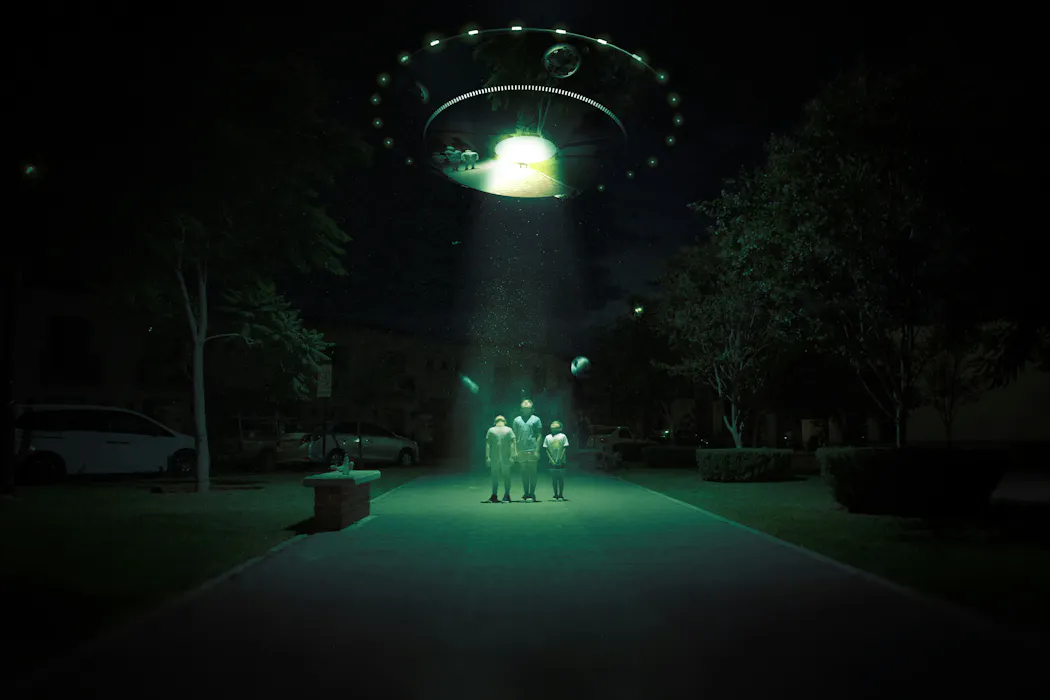
Danie Franco/Unsplash Amanda Lohrey’s Capture plays out as a sequence of conversations in strange rooms. The centre of the novel is the consulting room of psychiatrist James Mather, lately stripped of all its therapeutic paintings and suggestive curios to a state of clinical blankness. There is also the apartment where the psychiatrist and his former lover regard each other from “two enormous couches in the centre of the room”. And there are the rooms of a shiatsu sensei, cavernous and empty, except for a “big glass aquarium of shimmering fish”. Shadowing all these rooms, in this novel of the ordinary and the divine, are the dream-interiors of UFOs. James is studying people who claim to have been abducted by aliens, and Capture is partly composed of his interviews with them. “I wake up in this weird room, this weird shiny room,” says Mary, a beautician. But it feels like every room in Lohrey’s novel is a weird shiny room, where humans are studied with curiosity and partial incomprehension. Review: Capture – Amanda Lohrey (Text Publishing) Lohrey was raised as a Catholic in postwar working-class Hobart. Though she fled the faith as a teenager, her fiction has always been concerned with the personal and political dimensions of belief. Her later career works – including the multi-award-winning The Labyrinth (2021) and The Conversion (2023) – all focus on myth, dreams and the limits of rationality. In these novels, a lonely and adrift protagonist takes on a quixotic project in the hope of giving their life a meaning and a shape. In Capture, Lohrey sketches James as a quietly self-doubting rationalist. Though he deals in symbols and narratives, he puts himself in the science camp. He does not read fiction because it “mostly lacks substance”. He keeps himself free from the “weeds of superstition”. His assistant, Lucy Cheng, is one of “you people in the humanities”: a historian with a doctorate on 19th-century medicine, who has a “healthy scepticism of the DSM” and an awareness of psychology’s history of oppression. “What, at any given moment,” Lucy asks, “is credible science?” To his colleagues, James is a man “radiating complacency”, yet his glassy demeanour is already faintly rippled with uncertainty. “We make it up as we go along,” he replies to Lucy’s question. “Unless we are adhering to a rigidly prescribed set of doctrines, how else could it be?” James wields his doubt as a professional virtue, but it also affects him in a more gnawingly existential way. After a long career, he is approaching retirement with a sense of incompleteness. Having broken his back coming off a motorbike in his twenties, the arthritic pain in his spine keeps returning him to a body he would prefer to transcend. So he takes up the alien capture research on a whim, as a last hurrah and a grand distraction. “By immersing myself in another reality I might disengage my mind from its prison of flesh and bone,” he thinks, “for in my worst moments, pain threatened to unhinge my sense of self.” What he expects is an enjoyably diverting cavalcade of Roswell truthers and hillbillies: “in my preparatory reading,” he says, “I have gained the impression that captives belonged to a lower socio-economic category, the kind of people prone to paranoid fears, and dreams so vivid they cannot be distinguished from reality.” Read more: Intellectual fearlessness, politics and the spiritual impulse: the remarkable career of Amanda Lohrey Everyday epiphanies There is something here of the liberal political imagination in the age of Trump, which too readily blames the rise of a post-truth world on poor people who are easily tricked. At first, the psychiatrist seems confident in his ability to explain away the experiences of his subjects. He concludes that his first case, Anthony, may be suffering “unconscious grief at the prospect of having no heirs,” which has “induced a psychotic episode”. James’s favoured technique is to get patients talking on their pet topic, watching how they light up and how they construct their narratives. He encourages the beautician Mary to detail the art of eyelash extensions, while he savours “the accuracy, indeed a kind of eloquence, with which she describes her technique.” He does the same to everyone. He encourages his assistant Lucy’s young son to monologue about Transformers, and his grown-up son to rhapsodise about bread baking. “I am content to listen as he describes his art,” he says. This is how the psychiatrist understands other humans, but these are also moments when he finds humans to be at their most obsessive, arcane and alien. Rituals and icons – the “everyday epiphany” of a fresh loaf of bread, or the plastic gods of a small child – belong to a realm of shamanic experience James cannot fully comprehend. “My psyche is stripped bare of consoling ritual,” he says, “and what remains is the pain in my spine.” Amanda Loh
📌 Kaynak
Bu özet The Conversation AU kaynağından otomatik derlenmiştir. Tamamı için orijinal habere gidin.
Orijinal haberi oku →