The sculptor who brought us the blob-like babies is back – and the blobs have evolved
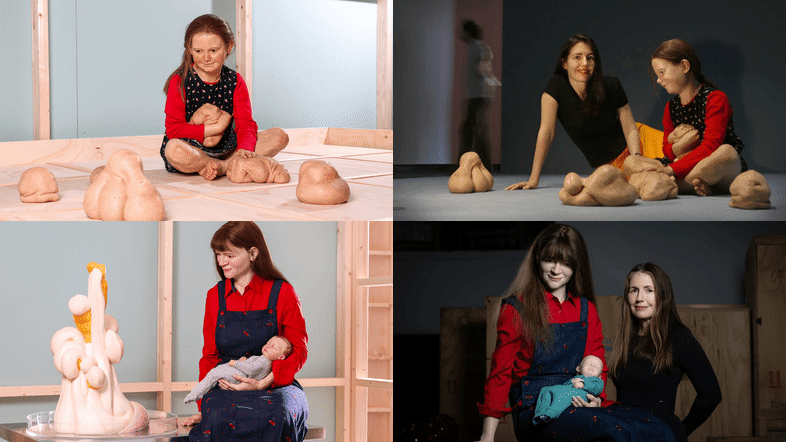
The acclaimed artist’s new commission for Science Gallery Melbourne is a call-back to her first hyperrealistic sculpture from 24 years ago.
Many of Patricia Piccinini’s artworks are long-term residents of the Uncanny Valley, the term coined by Japanese roboticist Masahiro Mori for the phenomenon of humanoid objects that look almost – but not quite – real, triggering unease or revulsion.
For the past two decades, Piccinini has created at once beautiful and disquieting sculptures, rendered in silicone and real hair, which at first glance appear lifelike. It quickly becomes clear that there’s something about them not entirely anchored in realism; there’s a push and pull between affection and repulsion.
But while they ultimately look purely fantastical, Piccinini’s works exploring the boundaries between the artificial and the natural are almost always rooted in real-life science and futuristic biotechnology.
Her first such silicone work was 2002’s Still Life With Stem Cells, a sculpture of a girl playing with strange, faceless creatures that challenge the viewer’s perception of what is real and what is artificial, or perhaps genetically modified. These blob-like creatures don’t look like animals, but the girl is cuddling one, and seemingly protective of the others.
Piccinini has had an interest in medical science since her teenage years, when her mother was diagnosed with cancer, and biotechnology and medical futurism has informed much of her work. Still Life With Stem Cells was created at a time when the technology was at a turning point. Research was well under way, but it was before the human genome project was completed. At the time, Piccinini described the piece as “a possible answer” to where that biotechological research was heading.
A quarter of a century later, stem-cell technology has advanced considerably, yet still feels almost from the realm of science fiction.
Which is why the acclaimed artist has revisited her original concept in a new commission for Science Gallery Melbourne’s EMERGENCE(Y) exhibition, showcasing artworks responding to a world shaped by climate crisis, and asking how humans and non-humans might need to adapt to survive.
As part of her artist residency with Science Gallery for the past year, Piccinini has spent time in the reNEW Melbourne labs at the Murdoch Children’s Research Institute, where she was able to witness stem cells growing in incubators and under the microscope, meeting the scientists working at the forefront of the technology.
Seeing the work being done there, she says when we meet at her inner-Melbourne studio, “was almost like science fiction”. She met teams all working on different organs, “and different kinds of ways of influencing the st
📌 Kaynak
Bu özet Sydney Morning Herald kaynağından otomatik derlenmiştir. Tamamı için orijinal habere gidin.
Orijinal haberi oku →