Hezbollah rejects renewed ceasefire agreed by Israel and Lebanon
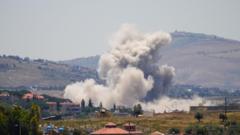
The United States announced the ceasefire agreement on Wednesday night following a fresh round of talks.
In a strongly-worded statement, the Iran-backed group's leader Naim Qassem said negotiations had been "futile" and "humiliating" for Lebanon, and rejected categorically by "broad segments of the Lebanese people".
It comes after Israel and Lebanon announced a renewal of their fragile ceasefire with the creation of "pilot" security zones inside Lebanon in which Hezbollah operatives would be banned.
In a joint statement released on Wednesday by the US State Department, the three countries said the deal was "contingent on a complete cessation" of fire by Hezbollah.
But responding on Thursday, the leader of Hezbollah - which was not part of the talks - said the "supposed ceasefire", interpreted as Hezbollah halting fire and withdrawing fighters from the southern front with Israel, amounted to surrender and would fulfil Israel's objectives.
The mood was similar on the streets of Beirut's southern suburbs - a stronghold of Hezbollah, also known as Dahieh - with a storekeeper expressing doubts about the agreement.
Sami, who has run his business there for 25 years, told the BBC: "You cannot have a ceasefire from one side, it's going to be an all side or no ceasefire."
There had been strikes in Lebanon on Thursday, he said. If this was supposed to be a truce, what did that make it?
"This is surrender. This is not a peace agreement. This is a surrender agreement," he added.
Across the road, Hadi, whose family store has been around for 35 years, said he saw no hope - and that this was not a new feeling.
"My generation, my dad's generation, my grandpa's generation, they didn't see anything of hope from these people - not necessarily the Israeli people. You can say the Israeli government," he said.
The agreement between Israel and Lebanon, reached after a fourth round of US-mediated talks in Washington, is contingent on the "evacuation of all [Hezbollah] operatives" from an area between the Israeli border and the Litani river, about 30km (19 miles) to the north, which is currently occupied by Israeli ground forces.
According to the deal, the US would help guide the creation of "pilot zones in which the Lebanese Armed Forces will take exclusive control of the territory to the exclusion of all non-state actors".
It did not include any maps to indicate where the pilot zones would be located, or any explanation of how they might work in practice.
The agreement followed a partial ceasefire announced on Monday, which Lebanon said would see Israel refrain from bombing the Lebanese capital, Beirut, in exchange for Hezbollah not attacking Israel.
The two countrie
📌 Kaynak
Bu özet BBC World kaynağından otomatik derlenmiştir. Tamamı için orijinal habere gidin.
Orijinal haberi oku →