These artworks were created for a lost exhibition. Fifty-one years on, they’re finally going on show
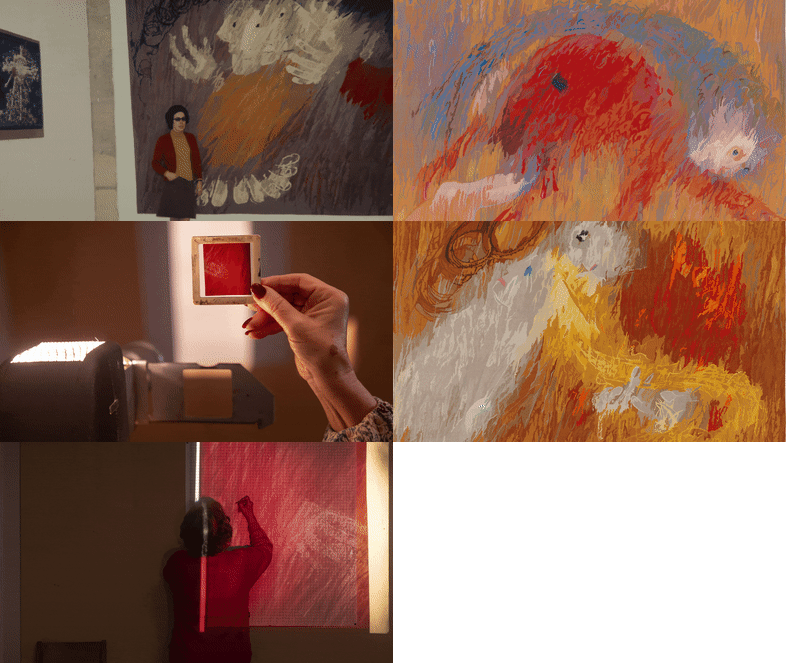
In the 1970s Arthur Boyd, the renowned Australian painter, commissioned a series of 20 tapestries that upon completion were never displayed together. This month, that changes.
In the 1970s Arthur Boyd, the renowned Australian painter, commissioned a series of 20 tapestries that upon completion were never displayed together. Next month, that changes.
There is a story about St Francis of Assisi taming the wolf of Gubbio. The legend goes that the fierce beast terrorised the Italian city, first by taking livestock and then turning its sights onto humans, waiting outside the city gates for anyone who ventured out alone.
Francis, a man with sainthood in his future and the habits of a wealthy gadabout in his past, had turned his back on a life of leisure and founded the Franciscan order. By the early 1200s, he had fully embraced poverty and nature, amassed a dedicated following and arrived in Gubbio ready to solve the city’s problem.
Against all warnings, the future saint sought out the wolf’s lair. When the wolf saw him, its demeanour changed completely. Suddenly docile and subservient, it placed a paw in Francis’ hand and quietly returned with him into the city of Gubbio.
In present-day Assisi, as I stand near the basilica where Francis’ remains are interred, a guide who grew up within the walls of the medieval town tells me this story and then pauses. It’s a metaphor of sorts, she explains. The story has changed in its telling over hundreds of years. Francis was real, and he lived his life near where we are standing. The wolf, however, was likely not an animal at all, but a person cast out by society. A bandit, perhaps, or a sex worker.
The point of this story, then, is about Francis’ love and care for all humans, irrespective of the stamps society puts on them. His own story is carefully told across a series of 13th-century frescoes in the nearby basilica, most likely by Giotto di Bondone, which spell out a chronology of a man who renounces an easy life and begins his journey into miracles and sainthood.
Gubbio, the city where Francis performed his miracle, has embraced the story as truth. There is a statue of a stately man and a tame wolf; every souvenir store sells magnets depicting the scene as literal fact. And maybe it was. In the late 1800s, centuries-old wolf bones were reportedly dug up during renovation of a church in the area.
When Arthur Boyd visited Italy in 1964, the story of St Francis wasn’t new to the celebrated Australian artist, but it suddenly took a grip of his imagination. He saw the frescoes, walked the same streets and subsequently spent the next decade imagining and retelling the story through drawings, paintings, lithographs and finally, tapestries.
Born in Murrumbeena in 1920, Boyd was the son of
📌 Kaynak
Bu özet Sydney Morning Herald kaynağından otomatik derlenmiştir. Tamamı için orijinal habere gidin.
Orijinal haberi oku →