Hidden supermassive black hole pairs may finally have a visible signal
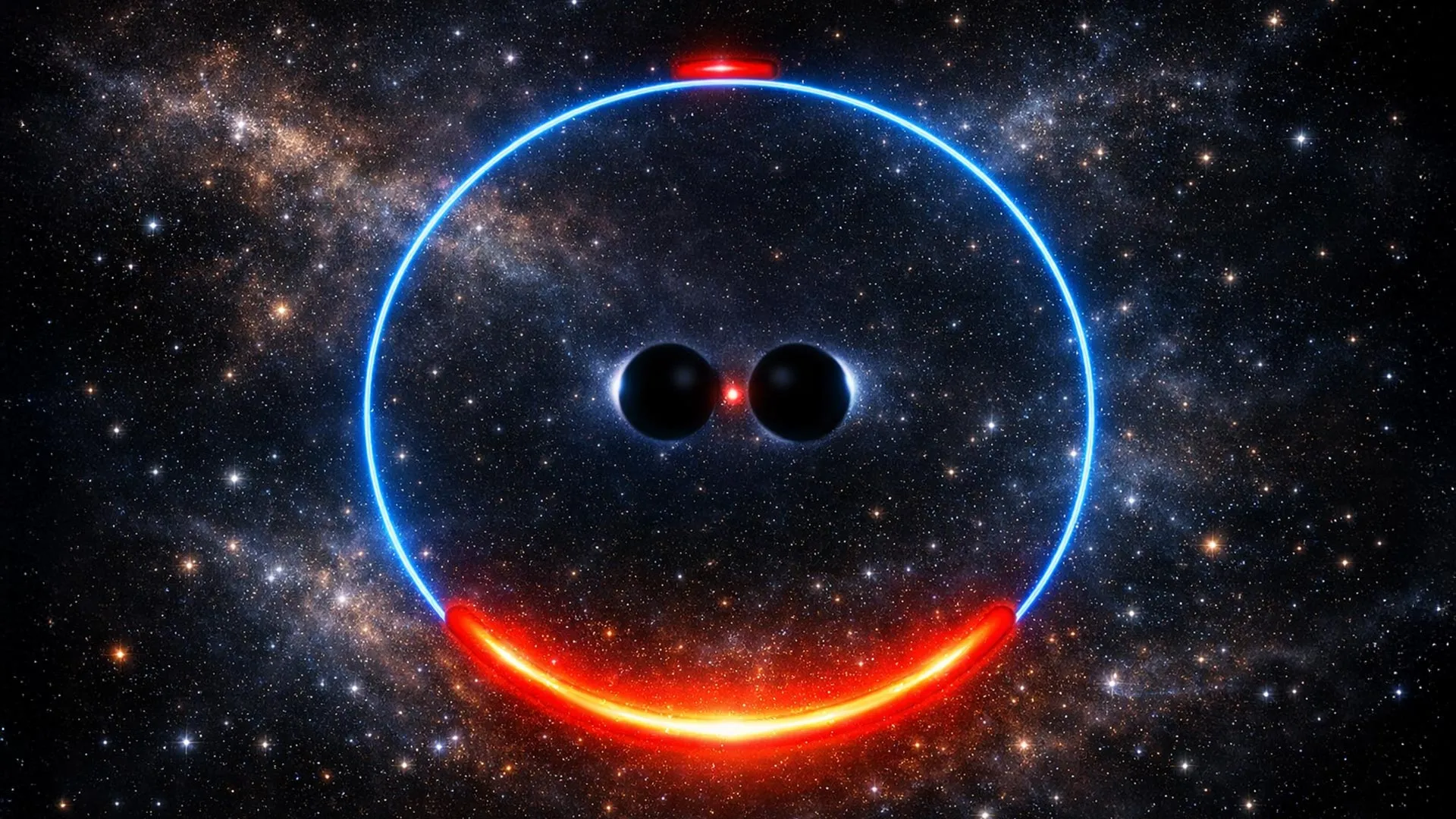
Scientists have proposed a new method for finding tightly bound supermassive black hole pairs by searching for stars that flash repeatedly as their light is magnified by the black holesâ gravity. The timing and brightness of these bursts could provide a unique fingerprint of black holes slowly spiraling toward a future collision.
Astronomers from the University of Oxford and the Max Planck Institute for Gravitational Physics (Albert Einstein Institute) have outlined a new strategy for uncovering one of the universe's most elusive objects: tightly bound pairs of supermassive black holes.
These giant black hole duos are expected to form naturally after galaxies merge. Although astronomers have identified some widely separated supermassive black hole pairs, finding those that orbit much closer together has proven far more difficult.
In a study published in Physical Review Letters, the researchers suggest searching for a distinctive signal. As the black holes orbit each other, their immense gravity could repeatedly magnify the light from stars located behind them, creating recurring flashes that may reveal the hidden systems.
Most galaxies contain a supermassive black hole at their center. When galaxies collide and eventually combine, their central black holes can become gravitationally bound, forming what scientists call a supermassive black hole binary.
These systems are important for understanding how galaxies evolve over time. They are also expected to generate some of the strongest gravitational waves in the universe.
Future space-based gravitational wave observatories should be able to detect these binaries directly. However, the new research suggests that astronomers may not have to wait. Existing and upcoming sky surveys could potentially identify them through their effects on visible light.
"Supermassive black holes act as natural telescopes," said Dr. Miguel Zumalacárregui from the Max Planck Institute for Gravitational Physics. "Because of their enormous mass and compact size, they strongly bend passing light. Starlight from the same host galaxy can be focused into extraordinarily bright images, a phenomenon known as gravitational lensing."
A single supermassive black hole can dramatically magnify a background star, but only when the alignment is almost perfect.
A binary system behaves differently. With two black holes acting as gravitational lenses, the region where extreme magnification can occur becomes much larger. The pair creates a diamond-shaped feature known as a caustic curve, where stars can appear dramatically brighter.
In theory, a perfectly point-like star could be magnified infinitely. In reality, the finite size of stars places a limit on how bright the effect can become.
"The chances of starlight being hugely amplified increase enormously for a binary compared to a single black hole," said Professor Bence Kocsis from the University of Oxford's Dep
📌 Kaynak
Bu özet ScienceDaily Tech kaynağından otomatik derlenmiştir. Tamamı için orijinal habere gidin.
Orijinal haberi oku →