AI in China's Steel Industry: Who Is Walking the Walk and Who Is Just Talking
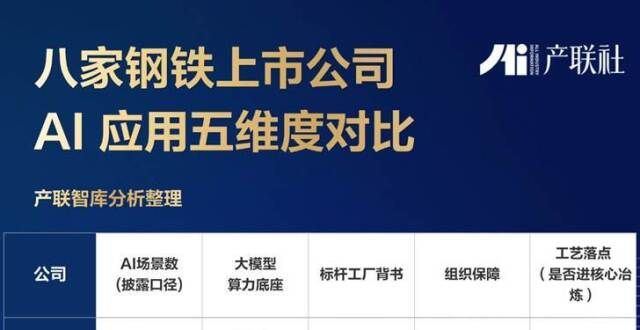
The annual reports of eight Chinese listed steel companies for fiscal year 2025 reveal a stark divergence in artificial intelligence adoption that cuts through the industry's homogeneity facade. While some producers are quietly building production-grade AI systems across their operations, others are dressing up group-level marketing slogans as technology strategy. The gap is not subtle. To cut through the noise, a five-dimension comparison framework was applied to each compan
The annual reports of eight Chinese listed steel companies for fiscal year 2025 reveal a stark divergence in artificial intelligence adoption that cuts through the industry's homogeneity facade. While some producers are quietly building production-grade AI systems across their operations, others are dressing up group-level marketing slogans as technology strategy. The gap is not subtle. To cut through the noise, a five-dimension comparison framework was applied to each company's disclosures: AI scenario count and specificity, deployed infrastructure architecture, dedicated organizational structure, measurable deployment metrics, and the proportion of group-level versus subsidiary-level execution. The results separate the builders from the talkers decisively. Baosteel stands alone at the front. The company reported 347 AI application scenarios across its operations, backed by a blast furnace large language model that optimizes smelting parameters in real time. This is not a pilot program — it is industrial AI at scale, deployed where raw physics meets data. Shougang, though smaller in raw numbers with only 8 scenarios, disclosed a clearly articulated four-layer AI architecture spanning perception, cognition, decision, and execution — suggesting thoughtful engineering rather than checkbox compliance. Valin Steel reported 46 AI scenarios supported by 261 operational industrial robots, offering concrete evidence of cyber-physical integration on the factory floor. Shandong Steel took a different but equally serious path by establishing a dedicated AI department that has delivered 138 projects, signaling institutional commitment rather than ad hoc experimentation. The picture darkens considerably at the other end of the spectrum. HBIS, Baotou Steel, and Masteel filled their annual reports with aspirational language about digital transformation and intelligent manufacturing, but the substance was thin. Their AI disclosures were overwhelmingly framed at the group holding level, with subsidiary-level execution almost entirely absent. When no single blast furnace, rolling line, or sintering plant is named alongside an AI deployment, the claim rings hollow. A critical caveat applies to this entire comparison: disclosure quality varies enormously, and disclosure quality is itself a signal. Companies with genuine AI operations tend to report specific, verifiable, and operationally grounded metrics. Companies with less to show tend to default to generic strategic boilerplate. In an industry where the difference between a 1 percent yield improvement and a theoretical smart factory vision can mean billions in margin, the market should treat vague language as data in its own right. The steel sector's AI race is real, but not everyone is running the same race — and the annual reports make clear who is on the track and who is still warming up in the hallway.
📌 Kaynak
Bu özet Pandaily kaynağından otomatik derlenmiştir. Tamamı için orijinal habere gidin.
Orijinal haberi oku →