Why storms that used to happen every 50 years are hitting more often
The weather is good for small talk . But it has been making big headlines more and more often. In the first five months of this year, many parts of South Africa have been battered by storms, floods and lasting or scorching heat, with the government issuing three notices of weather-related national disasters and official warnings about severe heat between January and May. Researchers agree that global warming caused by the release of large amounts of greenhouse gases from burn
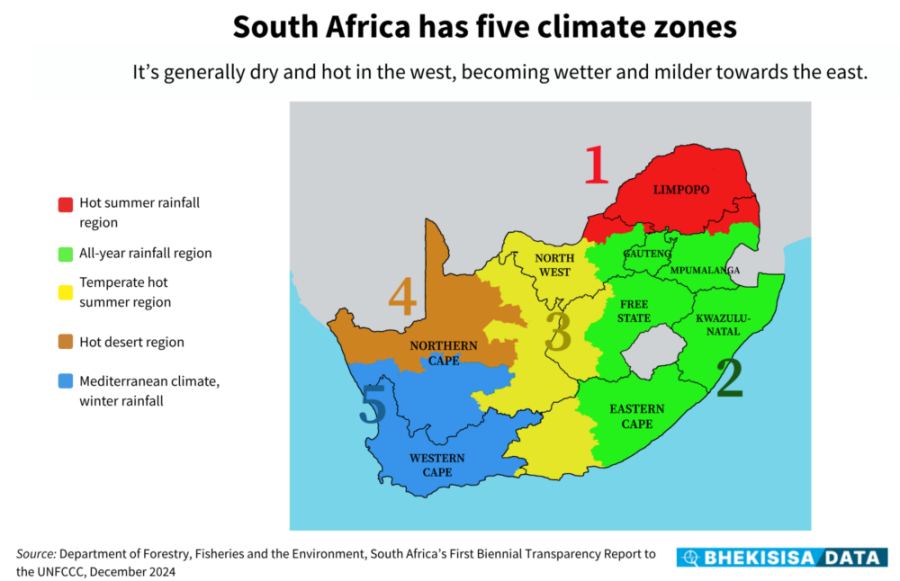
The weather is good for small talk . But it has been making big headlines more and more often. In the first five months of this year, many parts of South Africa have been battered by storms, floods and lasting or scorching heat, with the government issuing three notices of weather-related national disasters and official warnings about severe heat between January and May. Researchers agree that global warming caused by the release of large amounts of greenhouse gases from burning fossil fuels like coal and oil can be clearly linked to intense downpours and heavy storms happening more often . But how badly unexpectedly heavy weather will affect people’s lives depends on a combination of environmental factors and communities’ preparedness. “We are vulnerable to events which we may be able to forecast but whose actual intensity in specific locations we may not be able to predict,” said President Cyril Ramaphosa in a statement shortly after the spate of days of heavy weather in parts of the Western, Eastern and Northern Cape in early May, which took at least 10 lives , displaced thousands of people and badly damaged roads, buildings and utility systems. It is exactly this type of unpredictability that climate experts say the world has to stall itself against in the face of changing long-term weather patterns. But can every extreme weather event be pinned on climate change? To answer this, scientists compare how likely it would have been that an event of similar intensity would have occurred if the atmosphere had not warmed from what it had been about 150 years ago. For example, rainfall like what caused the heavy floods in parts of Limpopo, Mpumalanga and Mozambique in January probably occurs only every 50 years, researchers found , which makes it a rare event. But it would have been even rarer if the air had not warmed by about 1.3°C, their analyses showed. Moreover, datasets they looked at suggested that downpours during spells like these are becoming about 40% more intense. Having historic or baseline data to compare current events to is important to help scientists predict how things might change, which, in turn, can help decision-makers plan ahead so that the fallout of extreme weather can be handled better. In today’s story — the second in our series about what climate change could mean for South Africa — we look at what the data says about the country’s baseline and possible future weather patterns. Missed part 1? Read it here . One country, five climates South Africa has five distinct climate regions , with areas in the west generally being drier and hotter while those towards the east experience milder temperatures and wetter days. Where people live depends, to a large extent, on what weather patterns in an area look like. Places with a fairly mild temperature range and enough but not too much rain are often desirable, because there will probably be enough water and fertile soil to grow food. For example, about two-thirds of South Africa’s population live in climate zone 2 (covering Gauteng, Mpumalanga, KwaZulu-Natal, the Eastern Cape and parts of the Free State and North West), with mild temperatures and all-year rainfall, our analysis showed, whereas less than 1% of the population live in climate zone 4 (covering the Northern Cape), characterised by hot, desert-like conditions. (In our analysis, we used census data for 2022 to determine how districts fit into the approximate climate regions, which is why the coloured borders have ragged lines. In real life, zones won’t follow such exact boundaries.) But governance structures — and by implication how money is allocated for building and maintaining roads, schools and clinics and providing people with services like power, water and sanitation — don’t follow climate boundaries. Instead, the Constitution says treasury must give each province a fair amount of money from the available kitty based largely on the number of people in a province and their specific social or development needs. For the current financial year (2026/27), provinces have roughly R11 000 to R17 000 per person available — made up of the provincial allocation and a small amount from conditional grants — to care for their constituents (this excludes money that is given to national departments). A province like the Northern Cape, with a population of about 1.4 million people and spanning an area of about 373 000 km 2 that includes three different climates, will have less money available than, say, KwaZulu-Natal, which has nine times as many people but spread across only about a quarter of the size of the Northern Cape and falls into a single climate zone. Looking ahead Scientists, who helped put the government’s report together on how well the country is faring in sticking to its United Nations climate promises, modelled what changes in temperature, rainfall and dry spells could reasonably b
📌 Kaynak
Bu özet Mail & Guardian (ZA) kaynağından otomatik derlenmiştir. Tamamı için orijinal habere gidin.
Orijinal haberi oku →